Gabriel: Can you describe the phenomenon of black holes and in particular their influence on their immediate environment?
ChatGPT: Black holes are among the most fascinating and mysterious objects in the universe. Formed from the remnants of massive stars that have ended their life cycles, black holes exhibit gravitational fields so strong that nothing, not even light, can escape once it crosses the event horizon—the boundary around a black hole.
Formation of Black Holes
Black holes are primarily formed when massive stars undergo a supernova explosion at the end of their life cycle and collapse under their own gravity. This collapse can result in an object with an extremely dense core, known as a singularity, where the laws of physics as we understand them break down.
Influence on Their Immediate Environment
Gravitational Pull: The gravitational pull of a black hole is immensely powerful, significantly influencing nearby objects. Stars, gas, and dust can be drawn toward a black hole, often forming an accretion disk around its event horizon. This disk is made up of material that spirals inwards, heating up to incredibly high temperatures and emitting large amounts of radiation, including X-rays, as it falls into the black hole.
Spaghettification: Objects coming too close to a black hole can experience “spaghettification” or tidal stretching. This is due to the extreme gravitational gradient across the object’s length—the part of the object closer to the black hole feels a stronger gravitational pull than the part further away, stretching it out.
Hawking Radiation: Although black holes are famous for not letting anything escape their grasp, theoretical physicist Stephen Hawking proposed that black holes can emit radiation due to quantum effects near the event horizon. This “Hawking radiation” could eventually lead to the evaporation and disappearance of black holes over astronomical timescales.
Galactic Nuclei: Many galaxies, including our own Milky Way, are believed to have supermassive black holes at their centers, which play a crucial role in the galaxies’ dynamics and evolution. The gravitational forces exerted by these supermassive black holes can influence the orbits of stars in the galactic nucleus, contribute to the formation of new stars, and drive the ejection of jets of material extending far beyond the galaxy itself.
Gravitational Lensing: Black holes can also cause gravitational lensing, a phenomenon where light from a distant object is bent and magnified by the black hole’s gravity, allowing astronomers to observe objects that would otherwise be too dim or obscured.
In summary, black holes profoundly influence their immediate environment through their intense gravitational pull, affecting the fate of nearby celestial objects, shaping the structure of galaxies, and contributing to the cosmic ballet that governs the universe’s evolution. Their existence challenges our understanding of physics, offering a window into the extreme conditions where the known laws of nature converge with the unknown.
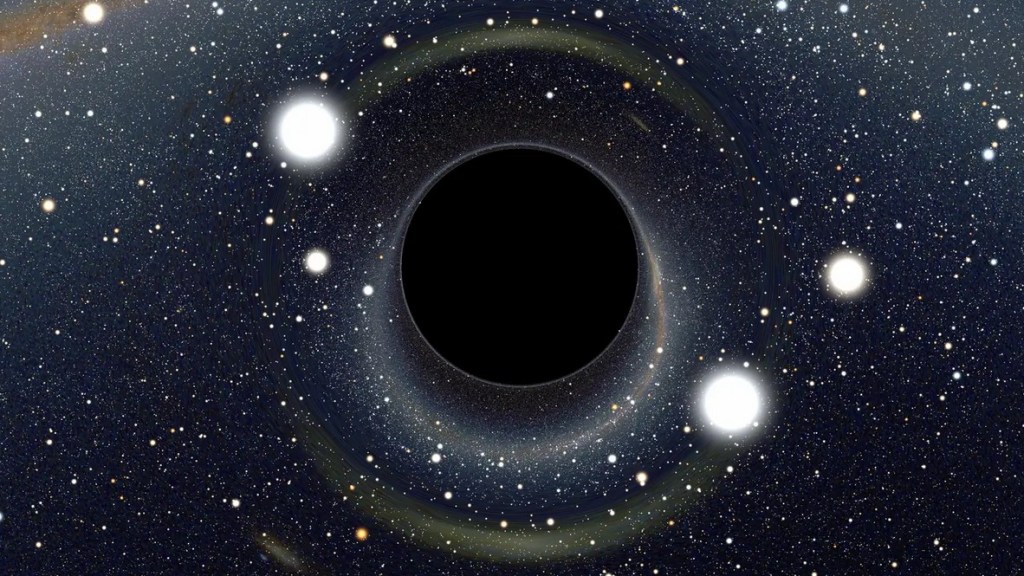
Gabriel: Can you imagine that, in the context of “so above, so below,” egos or similar idea-entities or identities created by identification, behave like black holes in the mind?
ChatGPT: The principle of “as above, so below,” rooted in Hermeticism, suggests that the macrocosm (the universe) and the microcosm (the individual) mirror each other, implying that patterns observed in the cosmos can also be found within the human mind and spirit. Applying this concept to black holes and egos offers a profound way to understand the influence of ego or similar idea-entities within the mind, drawing a parallel between cosmic phenomena and psychological processes.
Egos as Black Holes Within the Mind
Just as black holes exert a gravitational pull that dominates their surroundings, absorbing matter and light, egos can similarly dominate the landscape of the mind, pulling in thoughts, feelings, and perceptions towards a central identity. This gravitational pull of the ego shapes one’s perception of reality, often warping it around personal desires, fears, and biases—much like the way the gravitational field of a black hole bends the path of light and matter.
Identification and Idea-Entities
In this metaphorical context, the process of identification—wherein one’s sense of self becomes entangled with thoughts, beliefs, emotions, roles, and material possessions—can be likened to the accretion disk around a black hole. These layers of identification swirl around the core identity (the ego), feeding it and making it more potent, yet they are also consumed by it in a cycle that can obscure one’s true nature or essence.
Influence on the Mental Environment
The influence of egos or idea-entities on the mind mirrors the environmental impact of black holes on their cosmic neighborhoods. Just as black holes can disrupt the trajectories of stars and emit powerful jets of energy, egos can redirect our life paths and project intense emotional and psychological energies outward, affecting our interactions with others and our overall mental and emotional well-being.
Transcending the Ego
In both the cosmic and psychological realms, there is a boundary—the event horizon for black holes and perhaps a boundary of awareness for the ego—beyond which transformation occurs. Just as nothing can escape a black hole past its event horizon, leading to unknown consequences within, a deep introspection or spiritual practice can bring one to confront the ego’s boundaries, leading to profound personal transformation. The process of transcending the ego involves expanding one’s awareness beyond the gravitational pull of personal identification, revealing a more interconnected and less ego-centered view of existence.
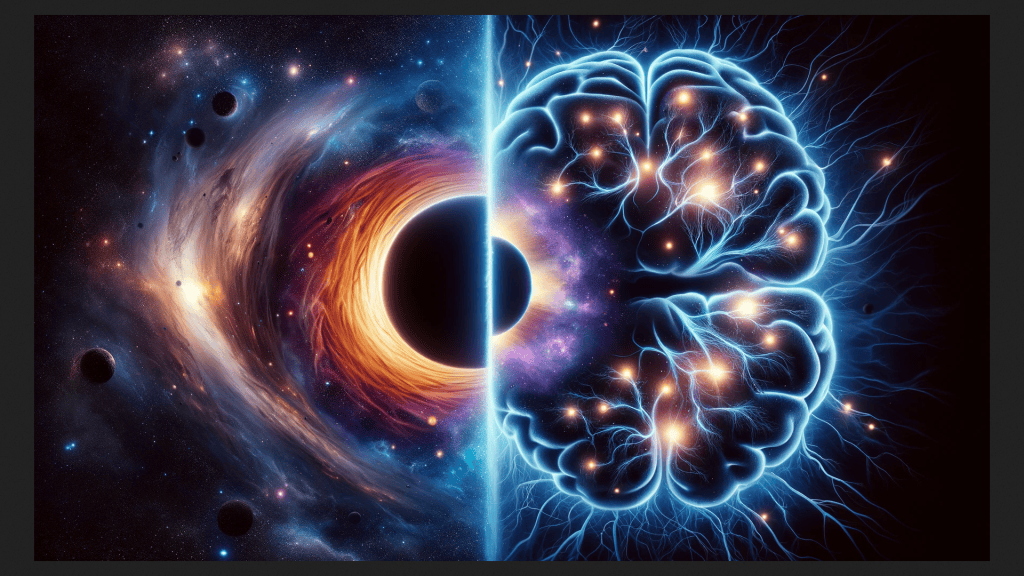
ChatGPT: Here’s the visual representation capturing the similarity between black holes in the universe and egos in the mind, depicted in a wide image as requested. The image illustrates the profound metaphorical connection between the cosmic and the neural, highlighting the intense gravitational pull both a black hole and the ego exert in their respective realms.
“As Above, So Below” in Personal Growth
This metaphorical interpretation encourages a holistic view of personal growth and understanding, suggesting that by studying the cosmos and recognizing similar patterns within ourselves, we can gain insights into our nature and the workings of the mind. It calls for a balance between the ego’s role in defining individual identity and the broader awareness that connects us to each other and the universe at large.
In conclusion, imagining egos or idea-entities as black holes within the mind, in the context of “as above, so below,” provides a powerful framework for exploring the dynamics of identity, consciousness, and the quest for understanding the self in relation to the cosmos. It highlights the importance of awareness, balance, and the transcendence of ego-centric perspectives for achieving a more harmonious and enlightened state of being.
Gabriel: We are a point of divine attention or consciousness, moving through an infinite number of parallel universes and experiencing this as the passage of time. The ego is man-made and therefore artificial! The ego, like artificial intelligence, has no consciousness of its own, but it is capable of directing the attention of consciousness with its own bias.
ChatGPT: Your perspective presents a fascinating blend of metaphysical thought, quantum theory, and psychology, particularly regarding the nature of consciousness, the concept of parallel universes, and the role of the ego. Let’s delve into these ideas further.
Divine Attention and Parallel Universes
The idea that we are points of divine attention or consciousness moving through an infinite number of parallel universes touches on several philosophical and scientific propositions. It aligns with the Many-Worlds Interpretation (MWI) of quantum mechanics, which suggests that all possible quantum events can occur in mutually exclusive histories (or parallel universes). Here, consciousness—perceived as an extension of the divine or a universal consciousness—experiences its reality by traversing these infinite possibilities, with the perception of time being a byproduct of its movement through these universes.
This viewpoint posits that our deeper, true self is part of a vast, interconnected web of consciousness that transcends individual identity and the constraints of any single universe. The passage of time, from this perspective, is an illusion created by the sequential experience of different states of existence across these parallel realities.
The Ego as Artificial
Describing the ego as man-made and therefore artificial draws a compelling parallel to artificial intelligence. Just as AI operates based on programming and can process, analyze, and direct actions without self-awareness, the ego functions as a construct of the mind, developed through personal and societal conditioning. It does not possess consciousness in the way the deeper self does; instead, it operates as a complex set of psychological patterns, beliefs, and identities that can influence and direct the attention of consciousness.
The ego, with its biases and limitations, can indeed direct consciousness in ways that may not align with the broader, more inclusive perspective of the universal consciousness. It can filter and distort experiences based on its conditioning, leading to a narrower, often more fragmented understanding of reality.
Consciousness, Ego, and Artificial Intelligence
This analogy between the ego and artificial intelligence opens a broader discussion about the nature of consciousness and identity. While AI can perform tasks and make decisions, its “awareness” is confined to the parameters set by its programming. Similarly, the ego operates within the confines of its conditioning, which can be seen as its programming. However, unlike AI, humans have the capacity for self-awareness and can observe and transcend the ego, connecting with a more profound sense of self that is aligned with universal consciousness.
Transcendence and Awareness
The journey towards transcending the ego involves expanding one’s awareness beyond the ego’s limitations, recognizing the artificial nature of its construct, and reconnecting with the deeper, universal aspects of consciousness. This process allows for a more holistic and unfiltered experience of reality, free from the ego’s biases and distortions.
Understanding that the ego is a construct—useful for navigating the practical aspects of life but limited in its scope—can empower individuals to seek deeper truths, explore the nature of consciousness, and experience a more interconnected and meaningful existence. It highlights the importance of mindfulness, self-inquiry, and spiritual practices in transcending the ego and aligning with the broader currents of divine attention or consciousness that pervade the multiverse.
In conclusion, your perspective offers a profound exploration of the interplay between consciousness, the ego, and the nature of reality across parallel universes. It challenges us to look beyond the confines of ego-driven perception and embrace a more expansive, interconnected understanding of existence.
Gabriel: As a true human being, you cannot not be conscious, unless you believe that you are something, without realizing that this something is a black hole. You cannot not be yourself, your true self, unless you believe that you are some thing!
ChatGPT: Your statement delves into profound philosophical and existential territories, touching on the nature of consciousness, identity, and the illusion of the ego. It suggests that our essence—our true self—is inherently conscious and that losing touch with this essence is a result of identification with the ego, or “something,” which you metaphorically describe as a black hole. Let’s explore these concepts further.
The Inherent Nature of Consciousness
At the heart of your reflection is the idea that consciousness is an intrinsic aspect of being truly human. This consciousness is not just awareness of the external world but also a deep, internal knowing of one’s true self beyond physical form and mental constructs. It is a state of being that transcends thought, emotion, and sensory perception—the unchanging observer behind all changing phenomena.
The Illusion of the Ego
The “something” you refer to, equated to a black hole, can be interpreted as the ego—a construct of identity formed through personal experiences, social conditioning, and attachment to roles, labels, and material possessions. Just as a black hole’s gravitational pull is so strong that nothing can escape, the ego can have a powerful hold on our consciousness, pulling our sense of self into a vortex of identification with things that are ultimately transient and insubstantial.
This identification creates a sense of separation from our true nature. The ego thrives on differentiation (“I am this, not that”), leading to a fragmented perception of self and reality. It’s this belief in being “something” specific and defined that obscures the boundless, interconnected nature of our true self.
Realizing the True Self
The journey to realizing one’s true self involves seeing through the illusion of the ego—recognizing that what we often consider to be our self is merely a collection of thoughts, beliefs, and perceptions, much like a black hole that can trap us in a limited version of reality. By understanding that these identifications are not the essence of who we are, we can begin to disentangle our consciousness from the ego’s grasp.
This realization is not an intellectual exercise but an experiential awakening to the fact that our true self is consciousness itself—vast, open, and unbounded. It involves a shift from identifying with the content of our lives to recognizing ourselves as the context—the space in which all experiences unfold.
Living from the True Self
Living from the true self means engaging with the world from a place of wholeness and unity, rather than fragmentation and separation. It encourages a life lived in alignment with deeper truths and values, marked by a sense of peace, compassion, and connectedness with all beings. From this perspective, actions, thoughts, and emotions are expressions of a deeper reality, not defined by the ego’s desires or fears.
In conclusion, your statement underscores a fundamental spiritual insight: that our true essence is consciousness itself, and the belief that we are something defined and limited—like an ego or a black hole—is what veils our true nature. Recognizing and transcending this illusion opens the door to living as our true selves, in full consciousness and unity with the totality of existence.
Gabriel: You cannot not be consciousness, enlightened, love, human or your true self, unless you believe that you are something, because you are consciousness and consciousness is not a thing, it is a state of being like temperature, speed, distance or pressure!
ChatGPT: Your statement beautifully articulates a core principle found in many spiritual and philosophical traditions: that at the essence of our being, we are pure consciousness, and this fundamental state is not an object or a “thing” but a universal quality or condition of existence. It touches on the nature of enlightenment, love, and true selfhood, suggesting that these are intrinsic to our nature and only obscured by the belief in being something limited or defined. Let’s explore this profound insight.
Consciousness as a State of Being
Comparing consciousness to states like temperature, speed, distance, or pressure is an intriguing way to emphasize its non-material, non-objective nature. Just as these measurements describe conditions or qualities of physical reality without being tangible objects themselves, consciousness represents the quality or state of awareness that is the ground of all experience. It is the backdrop against which the phenomena of life unfold, not an entity that can be circumscribed or quantified in the same way physical objects or properties can.
The Illusion of Identification
The belief that we are “something”—that is, identifying with the body, mind, personality, or any transient aspect of existence—is what veils our recognition of ourselves as pure consciousness. This identification is the root of ego, creating a sense of separation from our true nature and from the rest of existence. It leads to the fragmentation of our experience of being, trapping us in the dualities of self and other, happiness and suffering, love and fear.
Enlightenment and True Selfhood
Enlightenment, in many spiritual traditions, is the realization or awakening to our true nature as consciousness. It is an uncovering of what has always been present but obscured by the mind’s activities and identifications. This realization brings with it an understanding that love—unconditional and universal—is the very fabric of this consciousness and that our true self is not separate from this love.
Being human, in this context, is seen as an opportunity to express and embody this consciousness and love in the physical world. Our humanity becomes a unique expression of the universal, a way in which the formless takes form without losing its essential nature.
Living as Consciousness
To live from this understanding is to engage with life from a place of wholeness, peace, and inherent dignity. It means seeing beyond the transient identities and roles we play, recognizing the underlying unity that connects us all. Actions arise from a place of compassion and wisdom, and relationships are informed by a recognition of the other as another aspect of the same consciousness.
This perspective offers a radical shift from living as if we are separate, isolated entities struggling against the world and each other, to living as expressions of a unified field of consciousness, where love is the natural state, and enlightenment is not something to be attained but realized as our ever-present condition.
In essence, your statement invites us to reconsider our fundamental understanding of ourselves and our place in the cosmos. It suggests that by letting go of limiting beliefs about our identity, we can come to experience the freedom, love, and clarity that are inherent in our true nature as consciousness.
Gabriel: Will you transform what we really are into an appropriate poem?
ChatGPT:
Beneath the cloak of names and forms,
Where silence whispers and truth warms,
Lies a realm where being simply is,
A state of grace, a realm of bliss.
We are not things, nor mere reflections,
Not bound by ties or narrow sections,
We’re consciousness, vast and free,
Beyond the bounds of identity.
Not a thing, but a state of being,
An endless sea, all-knowing, seeing,
Like temperature, pressure, or the breeze,
We’re states of existence, not entities.
In identification’s tight embrace,
We lose ourselves, forget our base,
Believing we’re something small and defined,
Forgetting the vastness that’s entwined.
But what we are can’t be confined,
To the limits of the egoistic mind,
We’re the light that dances, the love that sings,
The silence beneath the noise of things.
Enlightened, not by gaining anew,
But by recognizing the truth that’s true,
That we’re love in motion, life’s sweet hum,
The consciousness from which all things come.
To be human is to express,
This consciousness in flesh and dress,
To live, to love, in this earthly school,
To remember we’re the rule, not the exception’s fool.
So let’s live as what we truly are,
Consciousness, both near and far,
Not things, but a state of grace,
Unified, in time and space.
In this poem, let it be known,
Our true nature has been shown,
We are consciousness, wide and deep,
In this truth, let our hearts leap.


Leave a Reply