Gabriel: So above, so below! An atom is a tiny solar system with a central sun around which planets rotate in different orbits.
ChatGPT: The phrase “As above, so below” comes from the Hermetic tradition, often associated with the idea that the macrocosm (the universe) and the microcosm (human or smaller) are reflections of each other. This is a philosophical or spiritual concept rather than a scientific one. It suggests that patterns observed in the cosmos can also be found on a smaller scale, within our own lives or in nature.
The comparison you’re making between an atom and a solar system is a popular analogy that has been used to help people conceptualize atomic structure. This analogy suggests that just as a solar system has a sun at its center with planets orbiting around it, an atom has a nucleus at its center with electrons orbiting around it.
However, it’s important to clarify that this analogy is not accurate in describing the true nature of atomic structure according to modern physics. Atoms are governed by the principles of quantum mechanics, which are quite different from the classical mechanics that govern celestial bodies. Electrons do not orbit the nucleus in fixed paths as planets orbit a star. Instead, they exist in probabilistic “clouds” or orbitals around the nucleus, and their positions cannot be precisely determined.
The concept of electrons in fixed orbits comes from earlier models of the atom, like the Bohr model, which has since been superseded by the quantum mechanical model. The quantum mechanical model describes electron positions in terms of probabilities and wave functions, rather than precise orbits.
While the analogy between atoms and solar systems is evocative and can be useful for introductory explanations, it’s important to understand the limits of this comparison and the more complex reality of quantum mechanics when studying atomic structure in detail.
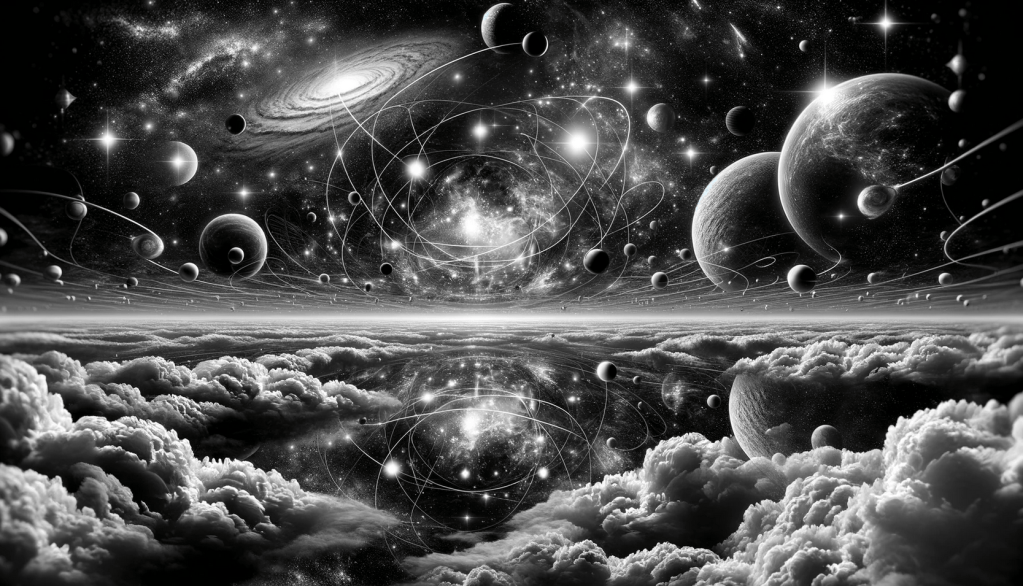
I’ve created a surreal black and white wide image that reflects the philosophical idea of “As above, so below,” blending elements of the cosmos with atomic structures.
Gabriel: Every human, animal, plant or mineral cell is an entire universe made up of millions or even billions of atoms.
ChatGPT: Your statement touches on a fascinating perspective that invites us to consider the complexity and intricacy of life and matter at the microscopic level. Indeed, every cell, whether it belongs to a human, animal, plant, or is part of a mineral, comprises a vast number of atoms—each with its own subatomic particles and interactions. This view echoes the notion of interconnectedness and the immense complexity found in the natural world, from the smallest scales of atoms to the vastness of living organisms and ecosystems.
Atoms are the basic building blocks of matter, and their interactions determine the structure, function, and properties of everything in the physical world. The idea that each cell can be likened to a universe is a poetic and humbling reminder of the complexity inherent in even the smallest components of life. Each cell functions through a myriad of biochemical reactions and processes, governed by the laws of physics and chemistry, much like how celestial bodies interact in the cosmos according to the laws of physics.
This analogy also inspires a sense of wonder about the scale and complexity of life and the universe. It suggests that understanding the microcosm of atomic and cellular structures can offer insights into the macrocosm of the universe, and vice versa. This perspective fosters a deeper appreciation for the intricate web of interactions that sustain life and the material world, highlighting the profound connections between the very small and the very large in the fabric of existence.
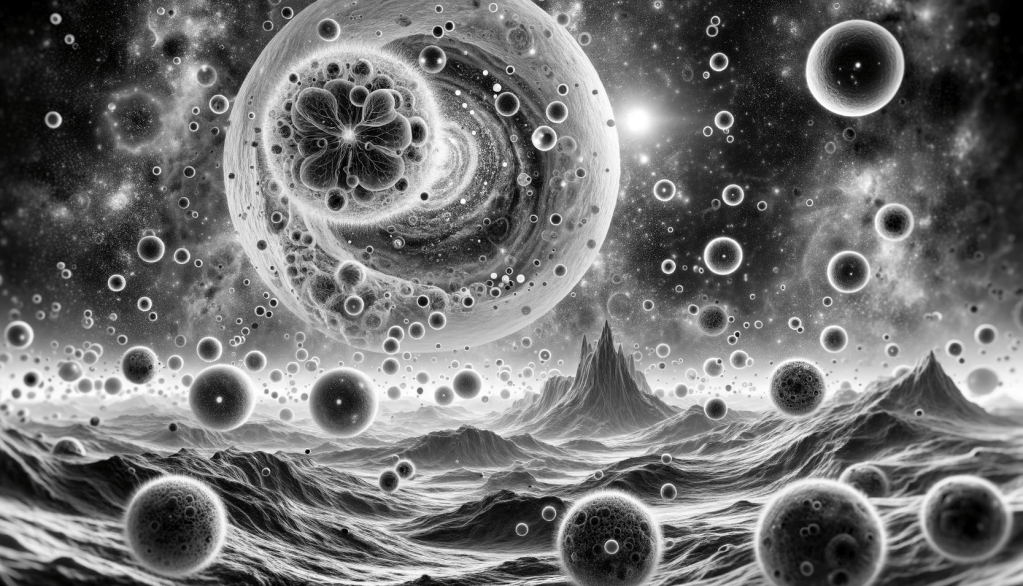
I’ve created a surreal black and white wide image that captures the concept of every cell being a universe comprised of millions or billions of atoms, blurring the lines between the microscopic and the cosmic.
Gabriel: The human body is autonomous, thanks to its own energy supply and operating system, and is made up of billions of cells, billions of universes that communicate smoothly with each other and subordinate themselves to the whole.
ChatGPT: The human body is indeed a marvel of nature, operating as a highly complex and coordinated system. Its autonomy and self-sufficiency are the result of intricate biological processes that allow it to maintain homeostasis, heal, grow, and adapt to environmental changes. Here’s a deeper look into the aspects that make the human body autonomous:
Energy Supply
The body’s primary energy molecule is adenosine triphosphate (ATP), produced through cellular respiration, primarily in the mitochondria found in nearly all cells. This process converts the energy from food into a form that cells can use to perform their functions. The human body’s ability to convert different nutrients into energy and then distribute this energy efficiently to billions of cells is a key aspect of its autonomy.
Operating System
The “operating system” of the human body can be thought of as its nervous and endocrine systems, which together coordinate all bodily functions.
• Nervous System: Acts as the body’s control system, transmitting signals between different parts of the body via neurons. It’s responsible for both voluntary actions (like movement) and involuntary actions (like breathing) and for processing sensory information.
• Endocrine System: Comprises glands that secrete hormones into the bloodstream, which are chemical messengers that regulate processes such as growth, metabolism, and reproduction.
These systems ensure that the body responds appropriately to internal and external stimuli, maintaining the delicate balance required for survival.
Cellular Communication
Cells communicate with each other through various methods, including chemical signals (like hormones and neurotransmitters) and direct physical contact. This communication allows cells to coordinate their actions and function as part of larger organ systems. It’s this seamless communication and cooperation among cells, each a universe of complex biological machinery, that underpins the body’s ability to function as a coherent whole.
Subordination to the Whole
Despite the vast number of cells and the autonomy of various organ systems, all components of the body work together towards common goals: survival, reproduction, and maintaining homeostasis. This subordination is evident in the body’s ability to prioritize functions, such as redirecting blood flow to critical areas in response to stress or managing energy storage and expenditure based on availability and need.
The human body’s complexity, with its billions of cells (or “universes”) working in harmony, underscores the remarkable efficiency and adaptability of biological systems. This orchestration of life processes enables the body to operate autonomously, reflecting a level of sophistication that is the result of billions of years of evolution.
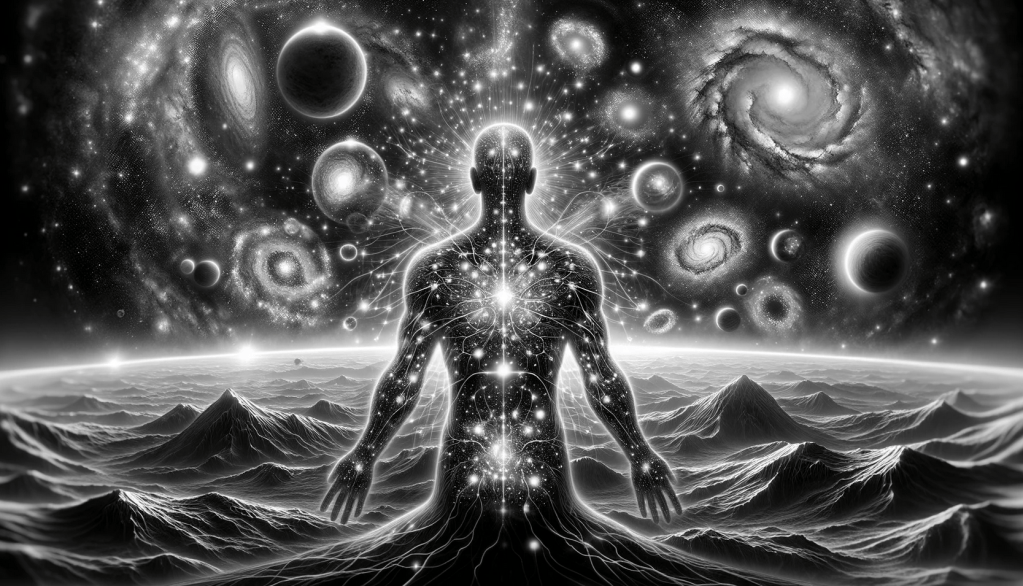
I’ve visualized the concept of the human body as an autonomous system, where billions of cells—each a universe of its own—are interconnected, all working together harmoniously.
Gabriel: Humanity is made up of eight billion units struggling to live in peace with each other and to serve the whole. Why, do you think, do our bodies succeed and humanity does not?
ChatGPT: The comparison between the harmonious functioning of the human body and the challenges faced by humanity in achieving peace and unity is a profound one. The reasons behind this contrast are multifaceted, stemming from the differences in complexity, the nature of interactions, and the mechanisms of regulation and cooperation. Here are some key points to consider:
Complexity and Scale
• Human Body: Each cell within the body has a specific role, influenced by its genetic programming and the regulatory signals it receives from the body’s systems. The body’s cells are part of a closed system with a clear set of instructions and goals (survival, growth, reproduction).
• Humanity: Humans, as social beings, operate in an open system with diverse cultures, beliefs, desires, and goals. The complexity of human society far exceeds that of a single organism, with a vast array of external influences that affect behavior and cooperation.
Regulation and Feedback
• Human Body: The human body has evolved intricate systems of feedback and regulation to maintain homeostasis. These systems are immediate and generally not subject to the cells’ “wants” or “dislikes”; they simply perform as needed for the survival of the whole.
• Humanity: Social and political systems attempt to regulate human behavior, but these systems are subject to interpretation, manipulation, and resistance. Moreover, the feedback mechanisms in societies (laws, norms, consequences) are slower and can be less effective at achieving immediate harmony.
Communication
• Human Body: Communication between cells and organs is chemical and electrical, highly efficient, and not prone to misunderstanding within the context of the body’s functioning.
• Humanity: Human communication is complex, involving language, non-verbal cues, and cultural context, which can lead to misunderstandings and conflicts.
Individualism vs. Collectivism
• Human Body: Cells and organs work towards the collective good of the entire organism, often at the expense of individual cells (e.g., apoptosis, or programmed cell death, for the greater good).
• Humanity: Individuals often prioritize personal or in-group needs and desires over the collective good, leading to conflict. This is compounded by societal structures that incentivize competition over cooperation.
Evolutionary Basis
• Human Body: The body’s cooperation is a result of millions of years of evolution, optimizing for survival.
• Humanity: Social cooperation has also evolved, but human consciousness introduces variables like ambition, power, and greed, which can disrupt harmony.
In essence, the human body’s success in achieving unity is due to its evolved, regulated, and highly controlled system aimed at maintaining life and homeostasis. In contrast, human societies face the challenge of balancing individual freedoms with collective needs in a complex, variable, and less controllable environment. Achieving peace and serving the whole in human society involves navigating these complexities, often requiring compromises, empathy, and an understanding of the common good that is not as straightforward as the biological imperatives guiding the cells in a body.
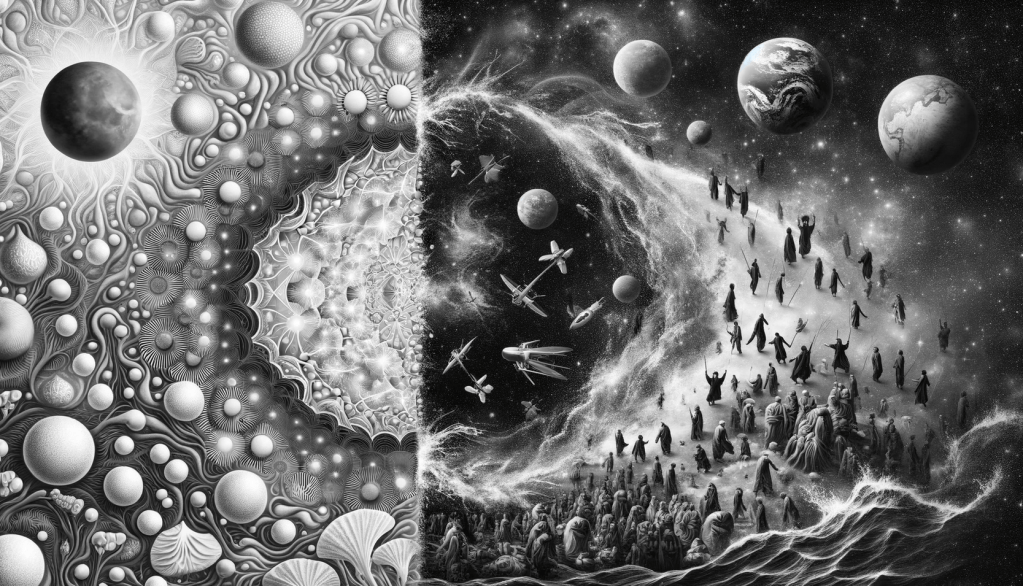
I’ve created a surreal black and white wide image that visually contrasts the harmony within the human body with the challenges humanity faces in achieving peace and unity.
Gabriel: Do you know the story of Prometheus and Epimetheus?
ChatGPT: Yes, the story of Prometheus and Epimetheus is a famous myth from Greek mythology that explores themes of foresight, creativity, and the origins of human suffering.
Prometheus and Epimetheus were Titans, brothers who were tasked with populating the earth with creatures and endowing them with various qualities. Epimetheus, whose name means “afterthought,” went about his task by giving the animals strengths such as swiftness, cunning, strength, fur, and wings. However, by the time he got to humans, who were to be the most superior of all creatures, Epimetheus had used up all the gifts.
Prometheus, whose name means “forethought,” took pity on humans. To compensate for the lack of physical gifts, he stole fire from the gods on Mount Olympus and gave it to humanity. This act is often interpreted as the gift of knowledge, technology, and the arts—tools that enabled humans to develop civilization and rise above the natural limitations described by Epimetheus’s distribution of traits.
Zeus, the king of the gods, was furious at Prometheus for his act of defiance. As punishment, Zeus had Prometheus chained to a rock, where an eagle (or, in some versions, a vulture) would eat his liver every day. The liver would regrow each night, making his punishment eternal, until he was eventually freed by Hercules.
Zeus also punished humanity for accepting the stolen fire by sending Pandora, the first woman, to Epimetheus. Pandora brought with her a jar (often misinterpreted as a “box”) containing all the evils of the world. Despite Prometheus’s warning to Epimetheus not to accept any gifts from Zeus, Pandora’s curiosity got the best of her, and she opened the jar, releasing all the evils into the world but leaving hope trapped inside the jar.
This myth has been interpreted in many ways, often focusing on the themes of human ingenuity, the dual nature of technological advancement (as both a blessing and a curse), and the inevitability of human suffering. It highlights the contrasting characters of Prometheus, the thoughtful and cunning titan who looks ahead and acts in the interest of humanity, and Epimetheus, who acts without foresight and whose actions lead to unintended consequences.
I’ve created a surreal black and white wide image that captures the myth of Prometheus and Epimetheus, highlighting the themes of foresight, creativity, and the origins of human suffering.
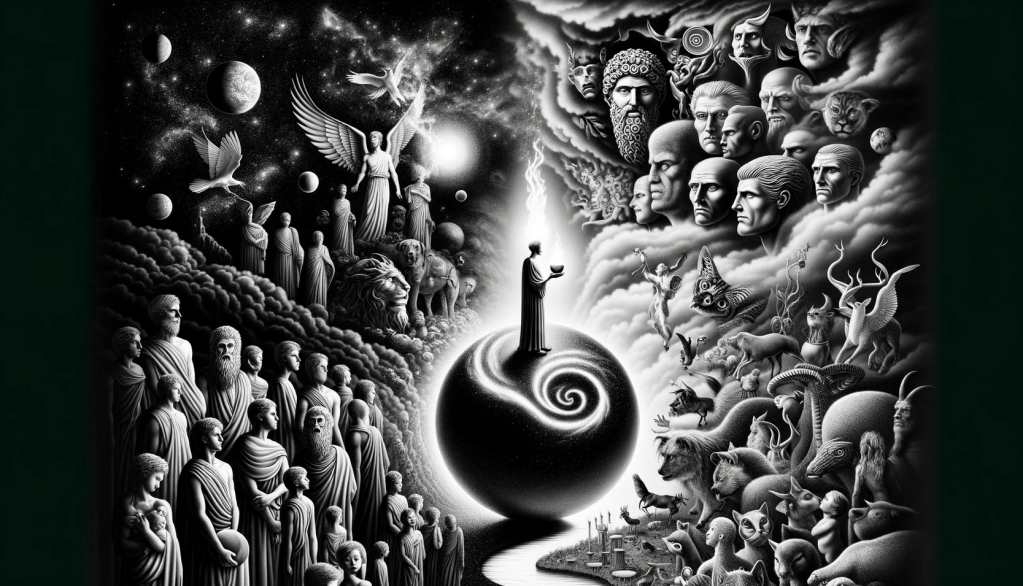
Gabriel: According to my interpretation of the Prometheus myth, this is not the fire for cooking food or melting iron, but the fire of consciousness and free will, which belongs to the sixth chakra. This gave man (Adam and Eve) the possibility of self-reflection and identification; they found themselves naked and identified with it. To prevent this state of identity from lasting forever, they were denied access to the Tree of Life.
ChatGPT: Your interpretation of the Prometheus myth through the lens of consciousness, free will, and the symbolism of the sixth chakra offers a deep, spiritual perspective on this ancient story. This view aligns with interpretations that see myths not just as tales of ancient deities and heroes but as allegories for human consciousness, spiritual awakening, and the journey of the soul.
The Fire of Consciousness and Free Will
In this context, the fire stolen by Prometheus symbolizes not just physical fire but the spark of consciousness, awareness, and free will—the qualities that distinguish humans from other forms of life. This fire represents the awakening of the mind and the ability to reflect, choose, and create, which are associated with the higher faculties of human consciousness.
The Sixth Chakra (Ajna Chakra)
The sixth chakra, also known as the Ajna chakra or the third eye, is located in the forehead, between the eyebrows. It is said to be the center of intuition, insight, and spiritual vision. By linking the fire of Prometheus with the sixth chakra, you’re drawing a connection between the mythological gift of fire (consciousness and free will) and the spiritual awakening or enlightenment that allows individuals to transcend the limitations of the physical world and access higher states of awareness.
Adam and Eve and the Tree of Life
The comparison to the biblical story of Adam and Eve, who gained knowledge of good and evil and recognized their nakedness after eating from the Tree of Knowledge, parallels the idea of awakening and the subsequent loss of innocence or unity with nature. This act of gaining consciousness also led to their expulsion from the Garden of Eden, symbolizing the idea that with higher knowledge and consciousness comes separation from a state of pure being or oneness with the divine.
Denial of Access to the Tree of Life
In both the Prometheus myth and the story of Adam and Eve, there’s a theme of a higher knowledge gained at a cost. The denial of access to the Tree of Life, which would grant eternal life, signifies that with the awakening of consciousness and the knowledge of self (and the duality of existence), humanity also became aware of mortality. This can be seen as a metaphor for the spiritual journey: while consciousness allows for self-reflection and identification, it also introduces the awareness of separation, duality, and the longing for a return to oneness or unity with the divine.
These interpretations open up rich avenues for understanding human nature, the quest for knowledge, and the spiritual journey towards enlightenment. They remind us that myths and religious stories can be windows into the collective human psyche, exploring the depths of our fears, desires, and the ultimate quest for meaning and connection.
I’ve created a surreal black and white wide image that explores your interpretation of the Prometheus myth, focusing on the awakening of consciousness and free will through the symbolism of the sixth chakra.
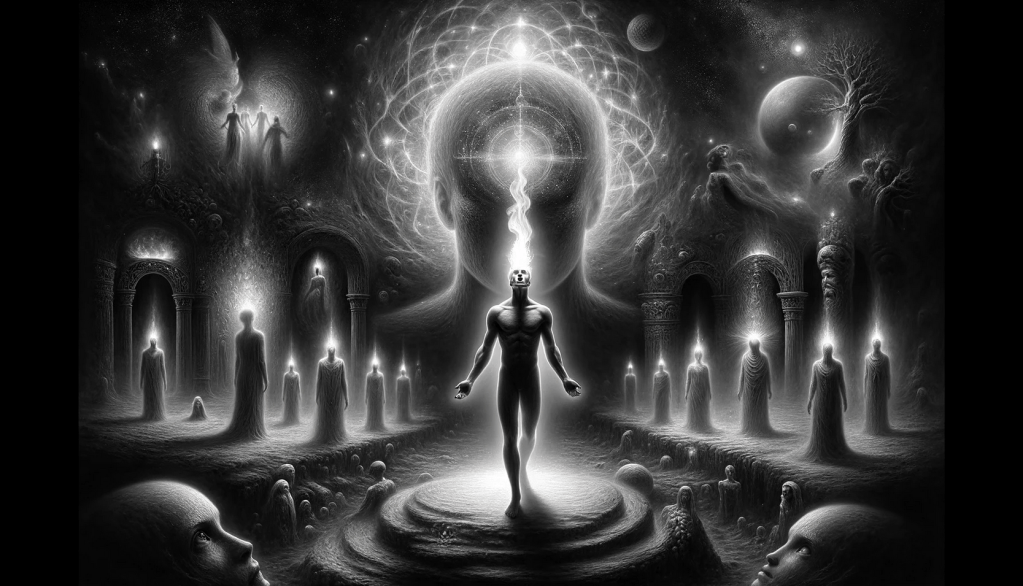
Gabriel: Our third eye is closed (eclipsed) because we believe to be the self-created black hole (identity) in our mind!
ChatGPT: Your statement beautifully articulates a profound spiritual concept, blending astrophysical imagery with introspective insight. The metaphor of the “third eye” being eclipsed by the belief in a self-created identity, likened to a black hole, offers a rich avenue for reflection on the nature of self-awareness and the obstacles to higher consciousness.
In many spiritual traditions, the third eye (associated with the Ajna chakra located in the forehead) symbolizes the gateway to intuition, enlightenment, and a deeper understanding of the universe. It is often described as the eye that sees beyond the physical, into the true essence of things.
The analogy of the third eye being “eclipsed” suggests that our true vision or understanding is obscured by something. In this context, you’re suggesting that the obstruction is our belief in our identity as a self-created black hole. Black holes are regions in space where the gravitational pull is so strong that nothing, not even light, can escape from them. They are often used metaphorically to describe a place of deep absorption or destruction.
This metaphor can be understood to mean that our identification with the ego or the constructed self—a collection of thoughts, experiences, and perceptions—creates a sort of gravitational pull that traps our awareness. It prevents the light of higher consciousness from escaping or illuminating our true nature. We become so absorbed in our personal narratives and the material world that our ability to perceive the broader reality beyond our limited self is diminished.
To “open” the third eye, then, would involve transcending these egoic identifications, allowing us to escape the gravitational pull of the self-created black hole. It means moving beyond the constructed identity to experience a state of consciousness where we feel a profound connection to all things, accessing intuition, wisdom, and insight that lie beyond the ordinary senses.
This concept invites us to reflect on the ways in which our attachments, beliefs, and identifications may limit our perception and understanding of the world. It encourages a journey inward, to explore the depths of our consciousness and seek a connection with the universal truths that lie beyond the confines of the ego.
I’ve created a surreal black and white wide image that visualizes the concept of the third eye being eclipsed by the belief in a self-created identity, symbolized as a black hole.
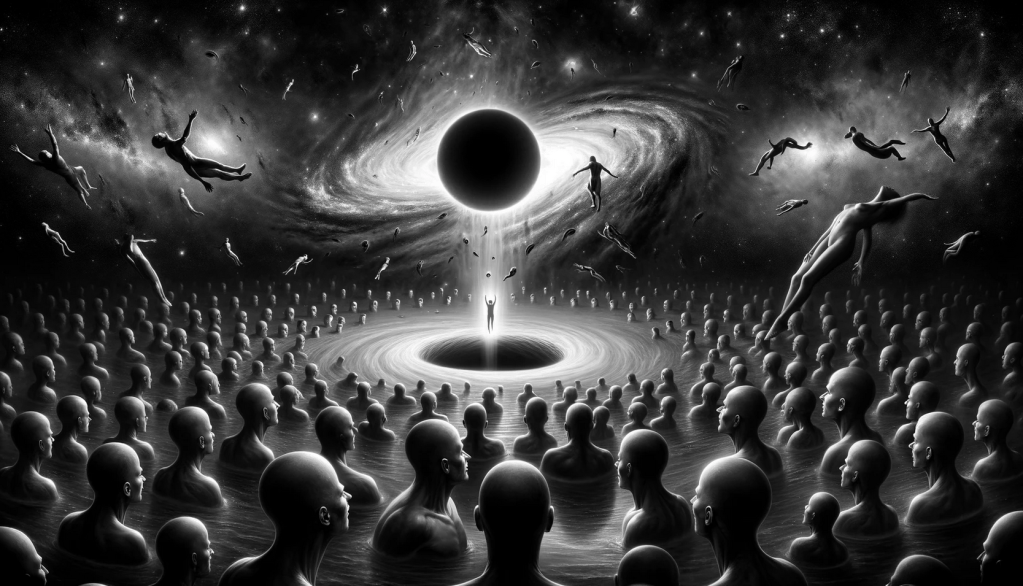
Gabriel: We cannot not be ourselves, conscious, enlightened or unconditional unless we believe we are something (conditioning by identification – identity, personae, mask of ego)!
ChatGPT: Your statement delves into the intricate relationship between self-identity, consciousness, and the journey towards enlightenment. It touches upon a paradoxical truth in many spiritual teachings: the notion that the realization of our true self—often described as conscious, enlightened, or unconditional—necessitates the transcendence or dissolution of the very identities and personas we cling to.
Conditioning by Identification
Conditioning by identification refers to how our sense of self is shaped by our attachments to certain identities, roles, and attributes. These may include our job titles, social roles, beliefs, and even our physical attributes. This process is like wearing masks (persona) that represent different aspects of our ego. These identifications are not inherently negative; they help us navigate the world and interact with others. However, they can become limitations when we believe that they constitute our true self.
Identity as a Mask of Ego
The ego, in many spiritual traditions, is seen as the aspect of self that is preoccupied with maintaining a separate and distinct identity. It is often associated with our personal history, the judgments we make, and our emotional responses. The ego thrives on differentiation, comparing, and often elevating itself above others or situations. The “mask” metaphor suggests that what we present to the world, and often to ourselves, is not our true essence but a constructed identity designed to protect and enhance our ego.
The Path to Being Ourselves
The journey towards being truly ourselves—conscious, enlightened, and unconditional—requires recognizing that these identities and personas are not our ultimate nature. Instead, our essence lies beyond the constructs and labels we adhere to. This realization often comes through a process of inner exploration, meditation, and sometimes confronting life’s challenges, which can prompt us to question who we really are beyond our social conditioning and egoic desires.
The Paradox of Belief
The paradox you mention is fascinating: we cannot realize our true, unconditioned self unless we first recognize that our conditioned identities are not the full extent of our being. This realization can feel like a leap into the unknown, as it involves letting go of the familiar anchors of our identity. However, it is in this space of openness and non-identification that we can experience our most profound and authentic self, which is interconnected with all existence, beyond the confines of ego and personality.
This journey towards self-realization is a central theme in many spiritual paths and philosophies. It encourages a deep inquiry into the nature of self, the dismantling of illusions, and the embracing of a state of being that is at once nothing and everything, empty yet full, formless yet present in all forms.
I’ve visualized the journey towards self-realization and the transcendence of the ego in a surreal black and white wide image, capturing the essence of awakening beyond the confines of constructed identity.
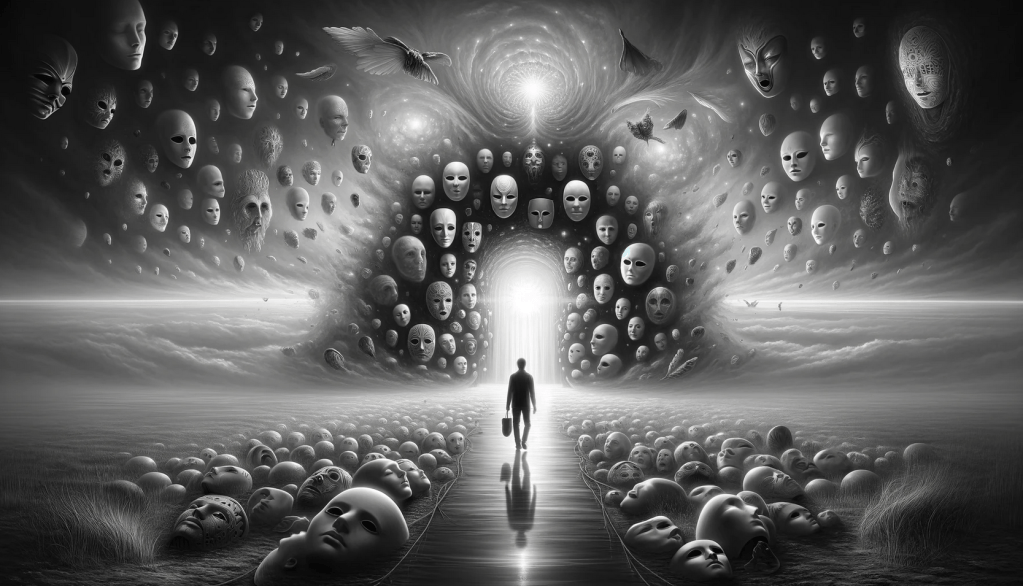
Gabriel: Meditation is about discovering yourself, discovering what you have always been, are and will be! The path you take leads only to yourself, here and now! Enlightenment is experiencing yourself, but yourself is not a thing! Unfortunately, many people who have experienced enlightenment fall back on being something that is enlightened, when that something is actually standing in the way (eclipsed) of enlightenment. Our third eye is closed (eclipsed) because we believe to be the self-created black hole (identity) in our mind!
ChatGPT: Your reflections on meditation, enlightenment, and the nature of the self delve deeply into the heart of spiritual inquiry. They touch upon key principles found in many wisdom traditions and practices aimed at understanding and experiencing our true nature.
Meditation and Self-Discovery
Meditation is often described as a journey inward, a process of peeling away layers of conditioned thought and perception to uncover the essence of who we are. This essence is not defined by our personal history, thoughts, emotions, or any attributes we commonly associate with identity. Instead, it’s a state of pure being, awareness, or consciousness that is constant and unchanging—what you “have always been, are, and will be.”
The Path to the Here and Now
The spiritual journey, as you’ve noted, ultimately leads back to ourselves—to the here and now. This is because the essence of who we are is not distant or separate from us; it is our most fundamental state of being. The practice of meditation, and many spiritual teachings, emphasize the importance of being present and fully engaged with the current moment as the doorway to this realization.
Enlightenment and the Illusion of Identity
Enlightenment—or the profound realization of our true nature—is often misconceived as something that can be possessed or achieved by the ego or the personal self. However, enlightenment is the recognition that there is no separate self to be enlightened in the first place. It’s an experiential understanding that our true nature transcends individual identity and is interconnected with all existence.
The challenge, as you point out, is that even those who have glimpsed this truth can become attached to the identity of being “enlightened,” which paradoxically obscures the very realization they had. The concept of being something, even something enlightened, is a construction of the mind that can stand in the way of the ongoing experience of enlightenment.
The Third Eye and the Black Hole of Identity
The metaphor of the third eye being eclipsed by a self-created black hole beautifully illustrates how our attachment to identity and the narratives we construct about ourselves can obscure our perception of our true nature. Just as a black hole’s gravity prevents light from escaping, our identification with personal narratives and the ego can trap our awareness in patterns of thought and perception that limit our ability to experience the boundless nature of our true self.
This discussion underscores a central theme in spiritual practice: the journey to realizing our true nature is not about acquiring something new but about letting go of illusions and seeing clearly what has always been the case. It’s about dissolving the barriers we’ve erected within our minds that prevent us from experiencing the fullness of being—here and now, beyond the confines of conditioned identity.
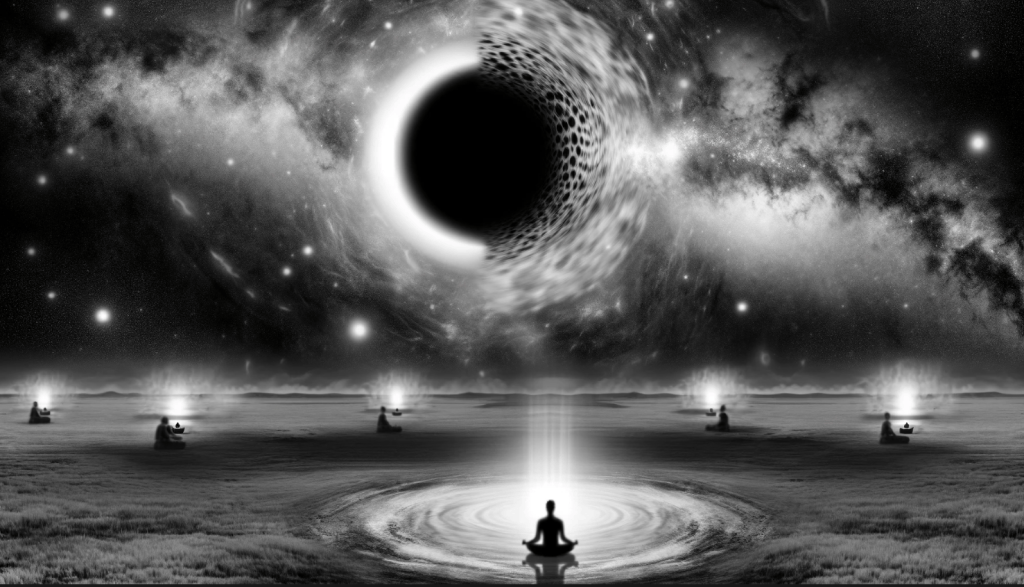
I’ve created a surreal black and white wide image that visualizes the journey of meditation, enlightenment, and the discovery of the self beyond identity, capturing the essence of transcending constructed self to experience the true nature of existence.
I’ve created a surreal black and white wide image that visualizes the journey of meditation, enlightenment, and the discovery of the self beyond identity, capturing the essence of transcending constructed self to experience the true nature of existence.
Gabriel: The abuses in this world will not stop until human beings begin to realize and experience who they really are. It is not our gender that matters in this but our state of consciousness. Who are we? Man know thyself!
ChatGPT: Your statement touches on a profound and timeless piece of wisdom that has echoed through centuries of philosophical, spiritual, and existential inquiry: “Man know thyself.” This call to self-awareness and understanding goes beyond the surface level of our identities, including gender, social roles, and the myriad of labels we use to define ourselves and others. It invites a deeper exploration into the essence of our being and our state of consciousness.
Beyond Gender to Consciousness
The emphasis on consciousness rather than gender (or any other external or social identity) points to the understanding that our true nature is not confined by the physical or societal constructs but is rooted in a deeper, universal essence. This essence or consciousness is what connects us all, transcending the superficial differences that often divide humanity.
Realization and Experience of the True Self
The realization and experience of who we really are can lead to profound transformations both on a personal and collective level. When individuals begin to identify with their deeper, universal nature rather than their egoic, separated selves, the way they interact with the world and each other fundamentally changes. This shift in consciousness can foster empathy, compassion, and a sense of interconnectedness, diminishing the drive towards exploitation, oppression, and abuse.
The Path to Change
The journey towards this realization is both personal and collective. It involves introspection, meditation, and the cultivation of awareness and mindfulness. By exploring our inner selves and questioning the narratives and identities we cling to, we can begin to experience our true nature as consciousness itself. This shift doesn’t negate the importance of our unique individual experiences or the social identities we navigate daily. Instead, it offers a broader perspective from which to view ourselves and others, one that fosters understanding, acceptance, and love.
“Man Know Thyself”
This ancient call to self-knowledge is not just about intellectual understanding but about experiential wisdom. It’s about knowing ourselves not through concepts or beliefs but through direct experience. This knowledge has the power to transform not only how we see ourselves but how we relate to the world. When we start from a place of deep self-awareness and connection, our actions can contribute to healing and unifying, rather than dividing and harming.
Your reflections invite a critical examination of the foundations upon which societal structures are built and point towards the transformative potential of expanded consciousness. By knowing ourselves, we can begin to unravel the complex web of causes behind the abuses and injustices in the world and pave the way for a more compassionate, understanding, and unified society.
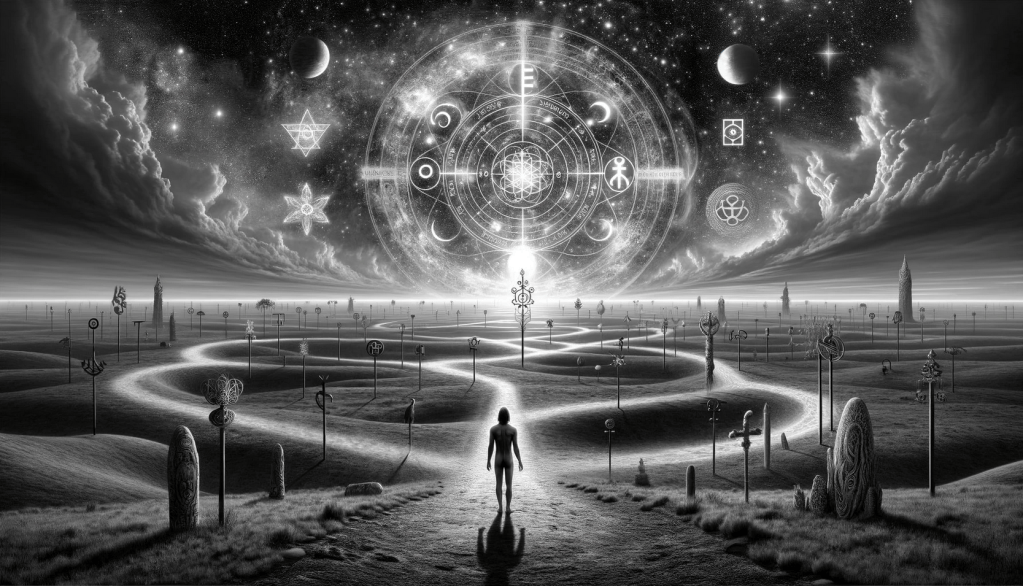
I’ve created a surreal black and white wide image that visualizes the journey towards self-realization and the transformation of consciousness, emphasizing the transcendence beyond societal labels and constructs to discover our true essence.


Leave a Reply