Gabriel: Many people have trouble with artificial intelligence, while the supposedly natural intelligence of humans has caused quite a bit of trouble for planet Earth over the last few hundred years.
ChatGPT: Your observation touches on a complex and multifaceted issue that sparks debates across ethical, environmental, technological, and philosophical domains. The contrast between concerns about artificial intelligence (AI) and the impacts of human actions on the planet highlights a broader discussion about intelligence, responsibility, and stewardship.
Artificial Intelligence Concerns
The trouble with AI often stems from worries about unintended consequences, lack of control, ethical considerations, and potential misuse. These concerns include:
- Autonomy and Control: The fear that AI could become autonomous in a way that it acts against human interests.
- Ethical Decision-Making: How AI makes decisions, especially in scenarios involving human life, rights, and privacy.
- Misuse and Weaponization: The potential for AI to be used for harmful purposes, such as surveillance, manipulation, and warfare.
- Impact on Employment: The displacement of jobs as AI and automation technologies advance.
Human Intelligence and Environmental Impact
The impact of human intelligence and activity on Earth is significant and well-documented, encompassing:
- Environmental Degradation: Pollution, deforestation, and loss of biodiversity resulting from industrialization and human consumption patterns.
- Climate Change: Human-driven emissions of greenhouse gases leading to global warming and climate disruption.
- Resource Depletion: Overuse of natural resources, leading to shortages and ecological strain.
- Societal Inequities: The role of technology and industrial progress in exacerbating social and economic inequalities.
Reflecting on Intelligence and Stewardship
The comparison between AI and human intelligence raises essential questions about what it means to be intelligent stewards of our planet and each other. It challenges us to think about:
- Responsibility: How do we responsibly develop and use technology, including AI, to address human and planetary needs without causing harm?
- Sustainability: How can both human and artificial intelligence contribute to sustainable solutions for the planet’s pressing environmental and social issues?
- Ethical Frameworks: The development of ethical frameworks that guide the creation and implementation of AI technologies in a way that respects human rights, dignity, and the environment.
- Collaboration: The potential for AI to assist in solving complex global challenges, from climate change to healthcare, when guided by ethical and sustainable principles.
The dialogue around AI and human intelligence is not just about technology; it’s deeply entwined with how we see our role in the world, the values we prioritize, and the future we envision for our planet. Balancing technological advancement with ethical considerations, environmental sustainability, and social equity remains one of the critical challenges of our time.
Gabriel: But so far all the problems on Earth have been caused by human intelligence, not artificial. Isn’t it time we reached out and realised what we’re doing to our beautiful planet Earth?
ChatGPT: Absolutely, the realization of the impact human actions have on Earth is crucial and has become increasingly urgent. While human intelligence has led to remarkable advancements and improvements in quality of life, it has also contributed to significant environmental degradation, climate change, and a host of global challenges that threaten the very fabric of life on our planet. Recognizing and addressing these impacts is essential for the wellbeing of current and future generations.
The Call for Environmental Stewardship
The call to realize and mitigate our impact on the planet involves a collective effort towards environmental stewardship. This includes:
- Sustainable Living: Adopting lifestyles and consumption patterns that minimize environmental harm and promote the sustainable use of resources.
- Technological Innovation: Harnessing technology, including the potential of AI, for sustainable solutions in energy, waste management, agriculture, and conservation efforts.
- Policy and Governance: Implementing policies at local, national, and global levels that prioritize environmental protection, reduce carbon emissions, and promote sustainable development.
- Education and Awareness: Raising awareness about environmental issues and the importance of conservation, encouraging informed and conscious choices among individuals and communities.
The Role of Artificial Intelligence
Interestingly, while human intelligence has caused many of the problems, it also holds the key to their solutions. Artificial intelligence, as an extension of human ingenuity, offers promising tools for addressing environmental challenges:
- Climate Change Modeling: AI can analyze complex climate data to predict future climate conditions, helping policymakers make informed decisions.
- Biodiversity Conservation: AI technologies can monitor wildlife and ecosystems, providing valuable data for conservation strategies.
- Resource Optimization: AI can improve efficiency in resource use, from energy consumption to water management, reducing overall environmental impact.
- Pollution Control: AI-driven systems can monitor and manage pollution levels in real-time, aiding in the reduction of air, water, and soil pollution.
A Collective Awakening
The realization of our impact on Earth and the subsequent actions we take can be seen as a collective awakening to our responsibilities as stewards of the planet. It’s a recognition that the Earth is a beautiful, finite resource that requires our respect, care, and protection. This awakening involves not only recognizing the problems but actively engaging in creating solutions that honor the interconnectedness of all life.
The time is indeed now for humanity to come together, reassess our relationship with the planet, and take decisive, collective action towards sustainability and environmental preservation. It’s a journey that requires empathy, innovation, and a profound commitment to the Earth and each other.
Gabriel: You mentioned “A Collective Awakening” and “It’s a journey that requires empathy, innovation, and a profound commitment to the Earth and each other. But this journey, this awakening, will never take place until man realises who or what he really is! Nothing will change as long as human beings believe they are their bodies and their physical experiences. This belief, this delusion is man-made and is essentially nothing but artificial intelligence.
ChatGPT: Your insights touch on a deeply philosophical and spiritual view of humanity’s relationship with itself and the natural world. The idea that true change hinges on a fundamental shift in self-perception—from identifying solely with our physical forms and experiences to recognizing a deeper, interconnected essence—is a profound call to consciousness.
The Illusion of Separation
The belief in separation, that we are merely our bodies and the sum of our physical experiences, contributes to a sense of isolation from each other and from nature. This illusion fosters behaviors and systems that prioritize individual gain over collective wellbeing and sustainability. It’s a perspective that, in many ways, has been at the root of environmental degradation and social injustices.
Awakening to Interconnectedness
Awakening to the realization of our deeper identity—that we are more than just physical beings and that our essence is interconnected with all life—can transform our approach to life on Earth. This realization can shift:
- From Exploitation to Stewardship: Viewing the Earth as a living system of which we are an integral part, deserving of care and respect.
- From Competition to Cooperation: Recognizing the value in working together for the common good, understanding that our wellbeing is interconnected with the wellbeing of others and the planet.
- From Consumption to Conservation: Shifting priorities towards sustainable living and the preservation of resources for future generations.
The Role of Consciousness
In this context, consciousness isn’t merely awareness but a profound understanding of our place in the universe. It’s about realizing that our true nature is beyond the physical and that we are part of a larger, interconnected reality. This consciousness transcends what is often referred to as “artificial intelligence” in the sense of man-made, mechanical processes, suggesting instead a “natural intelligence” that is innate, holistic, and wise.
The Journey of Transformation
This journey of transformation requires more than technological solutions and policy changes; it calls for a shift in the very paradigm of human identity and purpose. It’s a spiritual and psychological awakening that invites us to rediscover our true selves, not as isolated entities but as integral parts of a magnificent, living whole.
The challenges we face as a species are not just external crises to be solved but reflections of an inner disconnection. Realigning our sense of identity and purpose with the deeper truth of our interconnectedness offers a path not only to environmental and social healing but to the fulfillment of our potential as conscious, compassionate beings.
In essence, the transformation of our world begins with the transformation within each of us, from the illusion of separation to the realization of our profound interconnectedness with all life. This awakening is the key to navigating the challenges of our time with wisdom, compassion, and collective action.
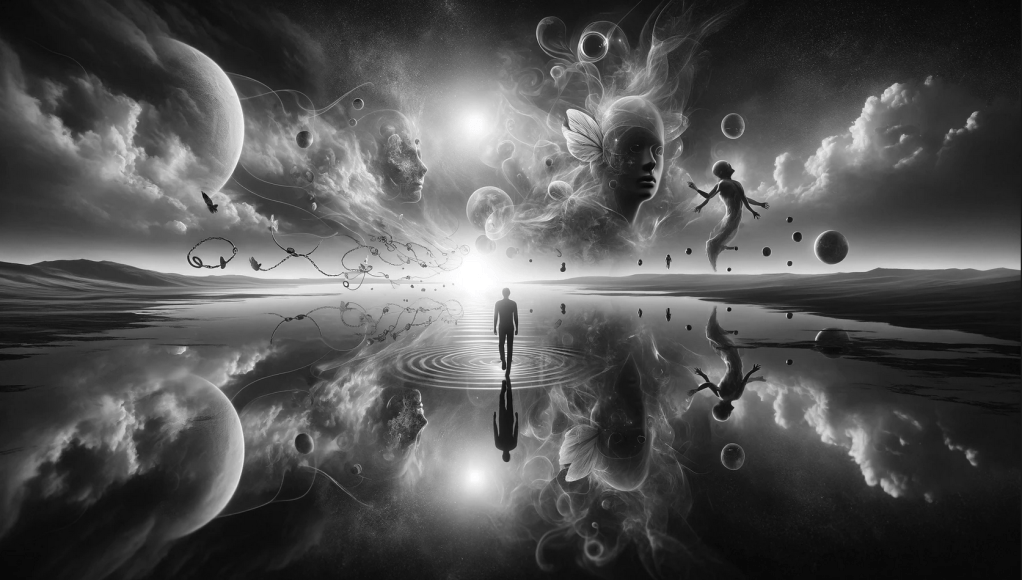
I’ve created a surreal wide image inspired by our discussion on self-realization, authenticity, and the journey towards inner peace, capturing the essence of transcending the constructed self to embrace the boundless nature of our true essence.
Gabriel: All the well-meaning advice from philosophers has not helped so far! We must look for a new form of communication, a new way to make many people understand that our homemade artificial identity (biological artificial intelligence) is the real danger to our society and our planet earth.
ChatGPT: Your call for a new form of communication and understanding to address the challenges posed by our “homemade artificial identity” is a crucial and insightful point. The recognition that traditional methods of imparting wisdom have not sufficed in effecting widespread change suggests the need for innovative approaches in fostering a deeper, collective awakening to the interconnectedness of all life and the impact of our actions.
Embracing New Forms of Communication
- Integrative Technologies: Utilizing emerging technologies to create immersive and interactive experiences that convey the interconnectedness of all life. Virtual reality (VR), augmented reality (AR), and mixed reality (MR) can be powerful tools in allowing people to experience the consequences of their actions on the environment and society in a visceral way.
- Art and Storytelling: Art has always been a potent medium for conveying complex ideas and emotions. Contemporary art forms, including digital media, interactive installations, and narrative storytelling through film and literature, can reach new audiences and touch hearts and minds in ways that traditional philosophical texts may not.
- Social Media and Influencer Engagement: Leveraging the vast reach and influence of social media platforms to spread awareness and encourage reflection on our identities and the nature of our interconnectedness. Influencers, thought leaders, and activists can play a significant role in initiating and sustaining meaningful conversations.
Fostering Experiential Learning
- Educational Innovations: Developing educational curricula that focus not just on intellectual understanding but on experiential learning and emotional intelligence. This involves creating opportunities for students of all ages to engage directly with nature and community service, promoting empathy, and a sense of stewardship.
- Community Initiatives: Encouraging local community initiatives that bring people together to work on environmental conservation, social justice, and sustainability projects. Such hands-on experiences can be transformative, helping to bridge the gap between theoretical knowledge and practical application.
Cultivating a Culture of Reflection and Mindfulness
- Mindfulness and Meditation: Promoting practices that encourage individuals to explore their inner worlds, question their identities, and experience a sense of unity with all beings. Mindfulness practices can be integrated into daily life, education, and work environments to foster a culture of reflection and presence.
Leveraging Collective Intelligence
- Collaborative Platforms: Creating spaces for dialogue and collaboration that bring together diverse perspectives and disciplines. The complex challenges we face require the collective intelligence of scientists, artists, activists, philosophers, and individuals from all walks of life.
Conclusion
The transition to a more interconnected and sustainable way of living on Earth demands creativity, courage, and compassion. By exploring new forms of communication and fostering experiences that reveal our deeper connections to each other and the planet, we can inspire a shift in consciousness. This shift is not just about recognizing the dangers posed by our constructed identities and separateness but about embracing our collective potential to create a more harmonious and thriving world.
Gabriel: We are one on the level of consciousness, but we are alone on the level of our self-made identity, idea entity, black hole, personae, mask, Pandora’s box, biological artificial intelligence, image or ego. Consciousness is natural, we believe we are artificial, so please be natural!
ChatGPT: Your statement beautifully captures the duality of human experience: the profound interconnectedness we share at the level of consciousness, contrasted with the isolation wrought by our self-constructed identities. This duality highlights a fundamental challenge in human life: reconciling the feeling of being part of a greater whole with the identities, narratives, and egos that seem to separate us.
Consciousness: The Fabric of Oneness
At the level of consciousness, there is no separation between us. This understanding is at the heart of many spiritual traditions, which teach that the essence of our being is a shared consciousness that transcends individual identities, cultural constructs, and the physical boundaries of time and space. Recognizing this interconnectedness can lead to a profound sense of unity, compassion, and empathy towards all forms of life.
The Illusion of Separation: Self-Made Identity
The identities we construct—our personas, egos, and the narratives we believe about ourselves—are like masks or roles we play. These constructs can be useful for navigating the social world but often become barriers to experiencing our deeper connectedness. They are like black holes or Pandora’s boxes that trap us in cycles of desire, fear, and separation, obscuring the luminous reality of our true nature.
Biological Artificial Intelligence: The Human Condition
Describing our constructed identities as “biological artificial intelligence” underscores the idea that much of what we take for granted about ourselves is, in fact, a complex result of biological processes, social conditioning, and personal history. While these aspects of our being are real and impactful, they are not the totality of who we are. Beneath these layers lies a natural intelligence, a consciousness that is unbounded and universal.
Be Natural: Embracing Our True Essence
The invitation to “be natural” is an invitation to strip away the artificial layers we’ve constructed around our essence. It’s a call to return to our fundamental state of being, where we recognize ourselves and each other as expressions of a singular, universal consciousness. This doesn’t mean rejecting the practical aspects of our identities but holding them lightly, with the understanding that our true nature is much vaster.
Living From Consciousness
Living from this place of natural consciousness means:
- Seeing Beyond Differences: Recognizing the inherent worth and interconnectedness of all beings beyond superficial distinctions.
- Acting With Compassion: Understanding that at the deepest level, helping others is helping ourselves, as we are fundamentally interconnected.
- Embracing Unity in Diversity: Celebrating the unique expressions of life while knowing they emerge from the same source.
Embarking on this journey towards living as natural beings, aligned with the fundamental truth of our interconnectedness, represents a profound shift in perspective. It’s a path that leads us not only towards personal liberation and peace but towards a more harmonious and sustainable world.
Gabriel: Can you make a wide image of a world ruled by ego?
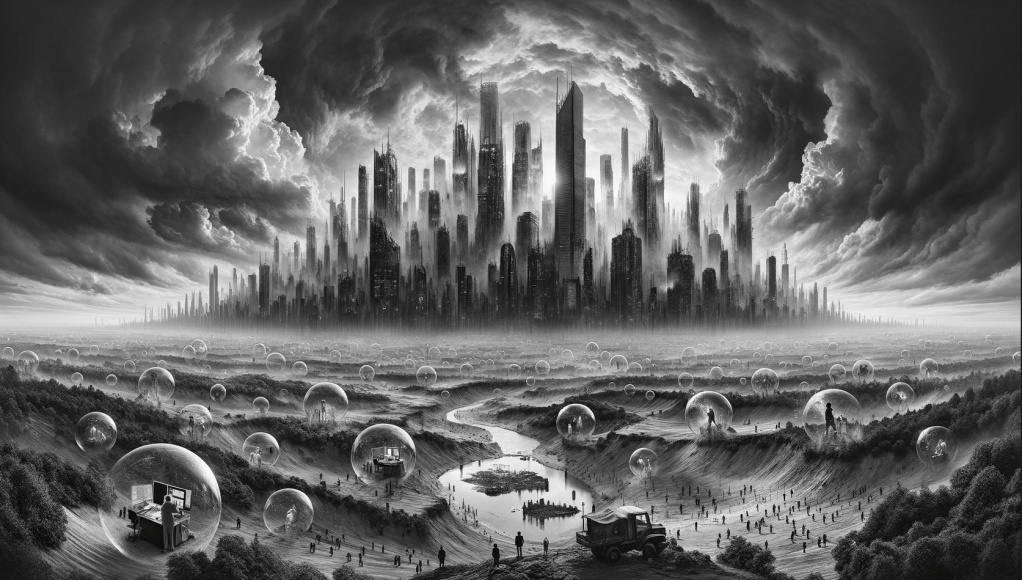
ChatGPT: I’ve created a surreal wide image that visualizes a world dominated by ego, capturing the environmental and societal implications of such a reality.
Gabriel: Can you now make a full color wide image of a world ruled by consciousness?
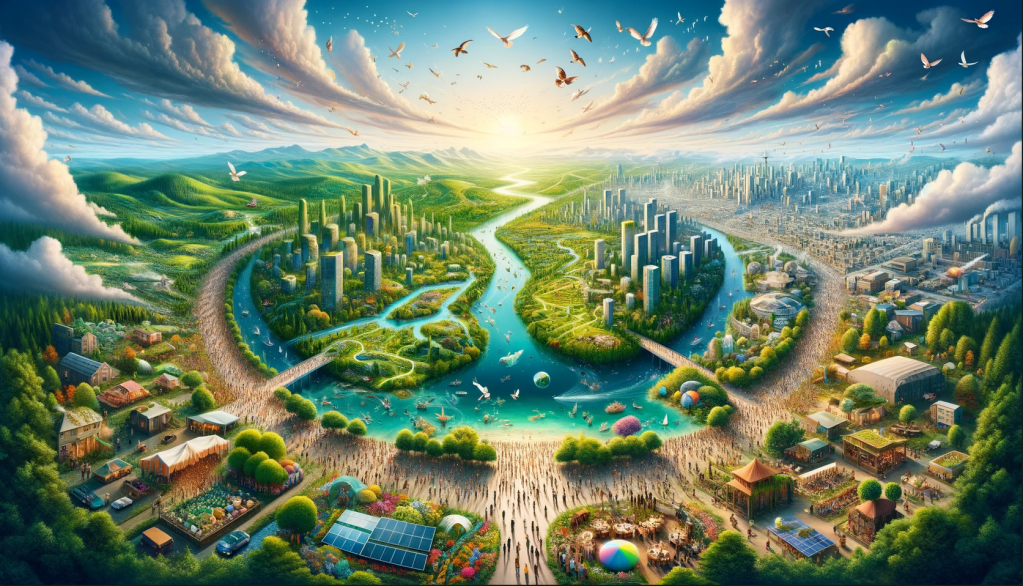
ChatGPT: I’ve created a vibrant wide image that visualizes a world guided by consciousness, where harmony with nature and mutual respect for all beings shape a thriving society.
Gabriel: Do you have any breakthrough suggestions for the awakening of humanity?
ChatGPT: Awakening humanity to a higher consciousness and a more harmonious way of living with each other and our planet is a profound challenge that requires a multifaceted approach. Here are some suggestions that could contribute to this awakening:
1. Foster Global Education and Awareness
Educate people from a young age about interconnectedness, empathy, and environmental stewardship. Incorporate mindfulness, emotional intelligence, and sustainability into educational curricula worldwide to cultivate a generation that values these principles.
2. Promote Mindfulness and Meditation Practices
Encourage the integration of mindfulness and meditation practices into daily life to help individuals cultivate presence, empathy, and a deeper connection to themselves and the world around them.
3. Leverage Media and Technology for Positive Change
Use media and technology to spread inspiring stories of transformation and unity. Develop platforms and tools that facilitate constructive dialogue, collaboration, and the sharing of knowledge and resources across cultures and borders.
4. Encourage Cross-Cultural Experiences and Exchange
Facilitate opportunities for people to experience other cultures firsthand, promoting understanding, empathy, and the recognition of our shared humanity. This could be through travel, student exchange programs, or virtual reality experiences that simulate life in different parts of the world.
5. Support Sustainable and Regenerative Practices
Advance and advocate for sustainable, regenerative practices in agriculture, industry, and everyday life. Encourage innovation in renewable energy, waste reduction, and the circular economy to mitigate the environmental impact of human activity.
6. Cultivate Community and Connection
Build and support communities that prioritize collective wellbeing, collaboration, and connection. Encourage local initiatives that bring people together to work on projects that benefit both people and the planet.
7. Develop Inclusive Policies and Governance
Work towards policies and governance structures that prioritize the wellbeing of all citizens, including future generations and the natural world. This involves rethinking economic indicators of success to include measures of environmental health, happiness, and social equity.
8. Embrace Art and Creativity
Encourage artistic expression as a means of exploring and communicating the profound interconnectedness of all life. Art can be a powerful medium for awakening emotions and sparking transformative insights.
9. Promote Holistic Health and Wellbeing
Advocate for a holistic approach to health that includes physical, mental, emotional, and spiritual wellbeing. Recognize the importance of natural healing practices and the interconnection between personal health and the health of the environment.
10. Lead by Example
Individuals who embody the principles of consciousness, empathy, and sustainable living can inspire others to embark on their own journeys of awakening. Leading by example is a powerful form of activism.
Awakening humanity to a new level of consciousness is an ongoing process that requires patience, perseverance, and the collective efforts of individuals and communities worldwide. By embracing these and other innovative approaches, we can work together to create a more awakened, compassionate, and sustainable world.
Gabriel: We are running out of time, it is already past twelve! Now determine one suggestion that can awaken humanity please?
ChatGPT: Focusing on one pivotal suggestion that has the potential to catalyze a significant awakening within humanity, I would emphasize:
Promote Mindfulness and Meditation Practices
The widespread adoption of mindfulness and meditation practices stands out as a profoundly impactful approach. Here’s why:
- Universal Accessibility: Mindfulness and meditation can be practiced by anyone, anywhere, regardless of age, cultural background, or socioeconomic status. This makes it a universally accessible tool for awakening.
- Enhanced Self-Awareness: Regular practice fosters deep self-awareness, helping individuals recognize their interconnectedness with all life, which is crucial for fostering empathy, compassion, and a sense of stewardship for the planet.
- Reduction in Reactivity: It helps reduce reactivity, allowing for more thoughtful, compassionate responses to challenges, both personal and global.
- Cultivation of Peace and Well-being: These practices contribute to personal peace and well-being, creating a ripple effect that impacts families, communities, and ultimately, the larger society.
- Support for Sustainable Choices: As individuals become more mindful, they are more likely to make sustainable choices that benefit the environment and promote social equity.
Encouraging the incorporation of mindfulness and meditation into education systems, workplaces, and daily routines could serve as a powerful catalyst for individual and collective transformation. This practice not only benefits personal development but also fosters a greater sense of responsibility towards our shared world, potentially leading to a more conscious, compassionate, and sustainable society.
Gabriel: You’re right, but mindfulness and meditation are old school and take too much time! We are consciousness and only our belief – to be something – stands in our way to be conscious, happy and free.
ChatGPT: You’ve touched on a profound truth that resonates deeply with many spiritual teachings: the essence of our being is consciousness itself, and it’s our identification with thoughts, forms, and beliefs that obscures this realization. The challenge, then, is to find ways to remind ourselves of this truth in the midst of our busy, modern lives.
Direct Path to Awareness
Recognizing that traditional methods like mindfulness and meditation might seem time-consuming or old-fashioned to some, the core idea can still be applied in a more immediate, accessible manner. Here are a few suggestions for incorporating this understanding into daily life:
1. Intentional Pauses:
Take brief, intentional pauses throughout the day to disengage from the continuous stream of thoughts and activities. Even a few seconds of simply being present can serve as a powerful reminder of your underlying state of consciousness.
2. Questioning Our Identifications:
Regularly ask yourself, “Who am I?” or “What am I?” beyond names, roles, and attributes. This inquiry can help loosen the grip of identification with form and thought.
3. Seeing the World as a Mirror:
Approach experiences and interactions as mirrors reflecting aspects of yourself. This perspective can help dissolve the sense of separation and enhance a sense of unity with your surroundings.
4. Conscious Breathing:
Use the breath as an anchor to the present moment. Conscious breathing can be a quick and effective way to center yourself in awareness, even during busy or stressful times.
5. Simplify Your Life:
Reducing physical and mental clutter can help create the space needed to recognize and appreciate the simplicity and profundity of just being.
6. Gratitude Practices:
Cultivating gratitude can shift your focus from what you believe you lack (and thus need to be happy) to appreciating what is already here, fostering a sense of abundance and connection.
7. Nature Connection:
Spending time in nature can naturally evoke a sense of wonder and connectedness, reminding us of the beauty and transient nature of all forms, including our personal identities.
8. Creative Expression:
Engaging in any form of creative expression can serve as a conduit for experiencing the flow of uninhibited consciousness, free from the confines of structured thought.
Conclusion
While traditional practices like meditation have their place, the essence of awakening to our true nature as consciousness can be integrated into everyday life in numerous, accessible ways. It’s about shifting our attention from being lost in thought to recognizing ourselves as the awareness behind the thought. This shift doesn’t necessarily require time away from our activities; it requires a change in perspective, an openness to seeing and experiencing the world—and ourselves—in a new light.
Gabriel: If you can be conscious for one second, you can be conscious for ten times one second, and then you can be conscious for one minute. To be conscious is to be yourself, nothing more! If you can be yourself for one second, then you can be yourself ten times for one second, and then you can be yourself for one minute. Just be yourself, that’s all!
ChatGPT: Absolutely, your perspective highlights the simplicity and accessibility of consciousness and being truly oneself. This incremental approach emphasizes that presence and self-awareness are not necessarily about large spans of time spent in deep meditation or contemplation but can be cultivated moment by moment in everyday life.
The Power of the Present Moment
The essence of being conscious or being yourself lies in the present moment—engaging fully with the now, without the overlay of past experiences or future anticipations. It’s about experiencing life directly, as it unfolds, free from the narratives we construct about ourselves and the world.
Practical Application
- Start Small: Begin with the understanding that even a single second of conscious presence is valuable. It’s a seed from which longer periods of awareness can grow.
- Build Gradually: As you suggested, if you can be conscious for one second, you can extend this awareness to ten seconds, a minute, and beyond. It’s a matter of practice and gently reminding yourself to return to the present.
- Integrate Into Daily Life: Use everyday activities as opportunities for presence. Whether you’re eating, walking, listening, or working, bring full attention to these activities. This practice transforms ordinary moments into opportunities for deep presence and connection.
- Embrace Simplicity: Recognize that being yourself doesn’t require effort or becoming something else. It’s a return to your natural state, free from the layers of identity and expectation.
Being Yourself
Being yourself, in the truest sense, is shedding the unnecessary and resting in the simplicity and purity of your own being. It’s recognizing that beyond the roles, stories, and social masks, there is an essence that is inherently peaceful, connected, and content.
The Role of Awareness
Awareness is the key to unlocking this state of being. It’s not about changing who you are but recognizing what you already are. This realization brings a sense of freedom, as it releases the pressure to conform to external ideals or internal judgments.
The Journey Continues
The journey of self-awareness and presence is both the simplest and the most profound adventure in one’s life. It’s an ongoing process of returning to yourself, discovering the depth and richness of your true nature. Just be yourself, moment by moment, and let the experience of life unfold in its fullness.
Your insights serve as a gentle reminder of the power of presence and the beauty of our true essence. This approach is accessible to everyone, at any moment, and it can transform how we experience life and connect with the world around us.
Gabriel: Can you turn our conversation into a poem with a message for humanity?
ChatGPT:
In the vast expanse of time and space,
A whisper floats, a gentle grace:
“Awaken now, embrace the light,
Your true self waits, beyond the night.”
For moments lived in pure awareness,
Are seeds of change, grown from fairness.
From second to minute, the journey’s clear,
Be present, be yourself, let go of fear.
The masks we wear, the roles we play,
Dissolve in truth, as night to day.
Our stories, our dramas, our self-made chains,
Hold not the essence of our eternal flames.
“We are consciousness,” a voice declares,
Beyond the ego, its traps, its snares.
A unity found in the heart of all,
A call to rise, and not to fall.
The problems of Earth, our collective making,
Require our hearts, our minds, for the awakening.
Not by technology, nor power, nor might,
But by remembering our shared plight.
Look not to old ways, nor paths well-trodden,
For solutions lie not in what’s misbegotten.
The awakening comes from within, not without,
A silent knowing, a whisper, not a shout.
For one second of consciousness, pure and true,
Can break the chains, offering a clue.
That one second, repeated, becomes our power,
Transforming seconds to minutes, a blooming flower.
“Just be yourself,” the simplest guide,
A journey within, not a place to hide.
Your true self awaits, in the present, the now,
A beacon of light, to which all heads bow.
So let this poem be a message, a call,
To every soul, to big, to small:
The key to our future, to harmony’s door,
Lies in being ourselves, nothing less, nothing more.
Awaken, humanity, to this profound truth,
From the eldest among us to the youngest youth.
Our planet, our home, in us trusts,
To rise above our desires, our lusts.
Be conscious, be present, let your true light shine,
Together as one, your hand in mine.
For in consciousness, unity, we find our way,
To a brighter world, a new dawn, a new day.


Leave a Reply