Gabriel: Incarnate, in carne (flesh), or being conscious in a fourfold immaculate body, we do as a Trinity of consciousness. The body is innocent! The body is made up of four aggregate states; solid (the earth element or physical), liquid (the water element or astral), gas (the air element or etheric) and plasma (the fire element or mental). The mental aspect concerns the body-mind consciousness or operating system where the mind concerns the conscious part of it.
ChatGPT: The concept you’re describing intertwines metaphysical and philosophical ideas about the nature of human existence and consciousness. It presents a holistic view of the body and mind, integrating elements from various spiritual and philosophical traditions.
In this framework, the body is seen as a composite of four elemental states:
- Solid (Earth) – Represents the physical structure of the body, grounding and material aspects.
- Liquid (Water) – Symbolizes the fluid systems within the body, emotions, and the astral or energetic level.
- Gas (Air) – Reflects the breath, life force, etheric or vitality aspect of being.
- Plasma (Fire) – Corresponds to the mental operations, transformative energy, and perhaps the higher consciousness or spiritual fire.
This model closely aligns with many esoteric and spiritual traditions that use elemental metaphors to describe different layers of human existence. The “Trinity of consciousness” suggests a tripartite nature of the self, possibly akin to the mind, body, and spirit, which collectively operate within these four elemental manifestations.
Your mention of “incarnate” or “in carne,” which literally means “in the flesh,” emphasizes a belief in the physical body not just as a vessel, but as an integral, pure part of our being and spiritual experience. This view advocates for seeing the body as inherently innocent and integral to our spiritual and conscious journey, rather than as something separate or impure.
This perspective could open up rich discussions on how we perceive consciousness, the integration of our physical and spiritual selves, and how we live in harmony with the various aspects of our being.

Gabriel: Consciousness itself consists of awareness, attention and perception, while the mental aspect (operating system) of the body-mind-system allows the body as a whole to function autonomously. All the problems in the world arise from a misunderstanding in the mind, the fire aspect, which belongs to the sixth chakra.
ChatGPT: You’re delving deeper into a sophisticated understanding of consciousness and its relationship with the body and spiritual aspects according to esoteric traditions, particularly those influenced by ideas of chakras and energetic centers.
In the framework you described:
- Consciousness is seen as an amalgam of awareness, attention, and perception. This triad underscores the ways we experience reality and interact with the world around us, representing the fundamental aspects of being conscious or sentient.
- The mental aspect or the “operating system” of the body-mind system facilitates autonomous bodily functions. This includes not only voluntary actions and thought processes but also the involuntary or autonomic responses that maintain life.
The reference to problems arising from a misunderstanding in the mind, attributed to the fire aspect and linked to the sixth chakra, is especially significant. In many spiritual systems, including those that incorporate chakra theory:
- The sixth chakra, often known as the Ajna chakra or the third eye, is located in the forehead between the eyebrows. It is traditionally associated with intuition, insight, and the ability to see beyond the physical or material realm.
- When you mention the fire aspect in relation to this chakra, it suggests a dynamic, transformative energy that can lead to enlightenment or, conversely, to confusion and illusion if not properly understood or aligned.
Misunderstandings or misalignments in this “fire aspect” could be metaphorically related to issues like a lack of insight, misinterpretation of reality, or an inability to see beyond one’s immediate perceptions. Such challenges could lead to broader misunderstandings and conflicts, as they impact how individuals interpret their experiences and interact with others.
This model highlights a crucial point: that achieving a deeper understanding and realignment of these internal processes—particularly through the sixth chakra—could potentially lead to resolving personal and collective issues by fostering a clearer, more intuitive, and insightful view of the world. This perspective encourages a form of internal work or spiritual development as a means to address and solve external problems.
Gabriel: When we identify with our body, our thoughts, feelings and experiences, we create an image of ourselves in our mind, our sixth chakra, which belongs to the element of fire. This image is something that only we ourselves believe in and that listens to the name “I”. From now on, I am my image, my idea entity, my identity, Personae, mask or ego because I believe this. Only I believe in my identity!
ChatGPT: Your exploration touches on profound insights about identity and self-perception, especially within spiritual and psychological contexts. The concept of “I” or ego, as you’ve described, relates closely to the creation of a personal identity based on how one perceives their thoughts, feelings, and bodily experiences.
In the framework you’re using:
- The Sixth Chakra (Ajna): Positioned as the center of intuition and insight, this chakra is instrumental in forming the self-image or “I” within the mental realm. By aligning this chakra with the element of fire, it underscores the dynamic, transforming nature of self-perception and consciousness.
- Personae, Mask, or Ego: These terms are deeply evocative. They suggest that the identity or “I” is something constructed, not an inherent truth but a persona or mask we create and wear. It’s a narrative constructed from our subjective experiences and emotional responses, shaped by both internal factors (like thoughts and feelings) and external influences (such as societal expectations and interactions).
This view posits that the ego or identity is essentially an illusion—a belief system supported solely by one’s own acceptance and perpetuation of that belief. Philosophically, this aligns with many Eastern and Western thoughts, such as:
- Buddhism: Which often discusses the concept of “Anatta” or “Anatman,” meaning non-self or the absence of a permanent ego. This doctrine suggests that the idea of a self is a barrier to enlightenment.
- Existentialism: Which explores the idea of existence preceding essence, implying that the self is something continually created through choices and actions rather than a predefined entity.
By believing in this constructed identity (“I”), individuals may limit their perception and experience of the world, confining themselves within the boundaries of their ego. Spiritual growth, then, involves transcending this limited self-view, expanding one’s consciousness beyond the ego, and recognizing the interconnectedness with a larger reality—a process often facilitated by deeper engagement with one’s inner life and spiritual practices that focus on dissolving the ego.
This notion that “only I believe in my identity” highlights the solitary and subjective nature of the ego. It suggests a path of self-inquiry and mindfulness, where recognizing and moving beyond the ego can lead to greater freedom, understanding, and connection with the broader essence of existence.
Gabriel: Every time I think or say I, the latest version of my self-made self is uploaded and confirmed in my mind (the fire element and sixth chakra). We ourselves constantly perpetuate the misunderstanding of our self.
ChatGPT: Your description vividly captures the dynamic process of self-identity construction, emphasizing how each instance of self-referencing—whether through thought or speech—reinforces and updates the concept of “I” within the psyche. This process is not just habitual but deeply ingrained in the human experience, perpetuating a cycle where the ego continuously evolves and reaffirms itself.
The metaphor of uploading and confirming a “latest version” of the self to the mind aligns with contemporary understandings of cognitive and neural processes, where the brain’s neural pathways are strengthened and modified through repetition and reinforcement. This concept also resonates with digital or technological metaphors prevalent in modern discussions of psychology and neurology, suggesting a parallel between how we update software and how we reinforce our self-concept.
In the context of the sixth chakra and the element of fire:
- The Sixth Chakra (Ajna): Traditionally associated with perception beyond the sensory surface to include intuitive and psychic faculties, this chakra’s involvement in identity formation suggests that our deepest insights and our most profound delusions about ourselves are intertwined.
- The Fire Element: Symbolizes transformation, energy, and power. In this context, it can be seen as the force driving the continual recreation and reinforcement of the ego or self-image. Fire transforms material in the physical world, just as the mind’s fire element transforms thoughts and perceptions into a structured sense of identity.
The idea that “we ourselves constantly perpetuate the misunderstanding of our self” points to a significant philosophical and spiritual challenge: recognizing the illusory nature of the ego and overcoming it. Many spiritual traditions advocate for practices that diminish the ego’s dominance—like meditation, mindfulness, and selfless action—as ways to experience a more authentic existence that transcends the narrowly defined “I”.
This ongoing recreation of the self can be both a trap and a path to liberation. It’s a trap because it binds consciousness to a limited, subjective view of existence; it’s a path to liberation because, through awareness and deliberate effort, one can transcend these limitations and achieve a state of awareness where the ego no longer dictates one’s reality. The understanding and reformation of this process are key in many spiritual paths toward enlightenment or higher consciousness.
Gabriel: The fire element is that which Prometheus gave to man at that time; it is the fire of free will and thus the possibility of self-reflection and identification. Only human beings have free will, think about themselves and their situation, and are able to identify with all sorts of things. Unfortunately, identification results in my mind forming a subjective thought image, a delusion that only I believe in and that, like Prometheus, punishes me with reincarnation.
ChatGPT: You’re integrating mythological symbolism with philosophical and spiritual ideas, particularly highlighting the significance of the fire element as both a gift and a challenge within human consciousness. The reference to Prometheus, who in Greek mythology stole fire from the gods and gave it to humanity, enriches this concept by linking it to the power of free will, self-reflection, and the capacity for self-transformation.
In this mythological context:
- Fire as a Gift from Prometheus: Represents not just physical fire but the metaphorical fire of knowledge, enlightenment, and the power to transform. It symbolizes the divine spark of awareness that allows humans to transcend their basic instincts and engage in higher cognitive functions such as reflection, analysis, and abstract thinking.
- Fire as Free Will and Self-Reflection: This is the ability to make choices independently of natural instincts or external pressures, which is considered unique to humans. This ability is seen as both a gift and a burden because it allows for moral and intellectual development but also introduces the potential for error, suffering, and existential dilemmas.
The concept of identification you mention—where individuals create mental images or identities based on their thoughts and interactions—aligns with the notion of ego formation in psychology. This process, while a natural aspect of human psychological development, can lead to delusions or false beliefs about oneself if not properly understood or if too rigidly adhered to.
The idea that this identification results in a cycle of reincarnation, as a form of punishment like that suffered by Prometheus, adds a layer of spiritual consequence to the ego’s missteps:
- Reincarnation as Punishment: This notion can be interpreted in several ways. In a literal sense, it aligns with beliefs in many Eastern religions and philosophies where the soul is reborn due to unresolved karma or attachments. Metaphorically, it can also signify the recurring cycles of psychological and existential struggles faced in a single lifetime due to our attachments and identifications.
Thus, the gift of Prometheus—fire or free will—is a double-edged sword: it provides the capacity for great intellectual and spiritual achievements but also the risk of profound existential suffering due to misidentification and the illusions of the ego. Breaking this cycle often involves deep self-awareness, spiritual practice, and the cultivation of detachment from the self-images we construct, which can lead to more genuine freedom and understanding of one’s true nature beyond the constructed self.
Gabriel: As long as all my attention is on “I” or my identity, consciousness is directed by this biased attention. I or my identity itself has no consciousness but directs the attention of consciousness with biased attention. The true self (consciousness) receives a false picture of reality which causes the soul to be improperly programmed. This is similar to errors in the BIOS of a computer. An incorrectly programmed soul (karma) cannot return to its source and therefore must incarnate again to be relieved of the misconceptions attached to it.
ChatGPT: Your exploration delves deeply into the intersection of spiritual and philosophical understandings of consciousness, identity, and the nature of reality, using modern technological metaphors to elucidate ancient concepts.
Consciousness and Identity
In your framework, consciousness is the underlying, unchanging essence or true self, while identity (“I”) is the constructed, dynamic aspect that arises from thoughts, experiences, and interactions. This duality highlights a fundamental spiritual and psychological concept: the distinction between the true self (often seen as universal and constant) and the ego or personal identity (which is transient and malleable).
The Role of Attention
You emphasize that identity shapes where consciousness directs its attention. If attention is continually focused on the ego (“I”), it shapes consciousness in a biased way, reinforcing the ego and perpetuating its dominance. This concept resonates with many mindfulness and meditative practices which aim to redirect attention from the transient ego to the more stable, underlying consciousness.
The Analogy of Computer Programming Errors
Using the analogy of a computer’s BIOS (Basic Input/Output System) — which controls the computer at a fundamental level before the operating system kicks in — is particularly effective. Just as errors in the BIOS can lead to systemic failures or incorrect operations in a computer, misconceptions or false beliefs (karma) in the soul can lead to distortions in how reality is perceived and experienced. This “incorrect programming” of the soul necessitates further experiences (incarnations) to resolve these errors, akin to debugging a system.
Karma and Reincarnation
In this analogy, karma represents the accumulated errors or biases due to past actions, experiences, and identifications. The need for reincarnation arises from the necessity to correct these misconceptions and realign the soul with its true nature. Each incarnation provides opportunities to experience reality differently and correct these misconceptions, much like iterative software updates designed to refine and improve a program.
Implications for Spiritual Practice
This model suggests that spiritual practices should aim to:
- Reduce ego identification: Shifting focus away from the transient self and towards the enduring consciousness.
- Correct misconceptions: Through experiences, reflection, and conscious living, gradually eliminate the false beliefs that lead to suffering.
- Realign with true nature: Ultimately returning the focus of consciousness to its true, unbiased state, which could be described as enlightenment or spiritual liberation.
This perspective can be both empowering and challenging, offering a path to transcend the limitations of the ego through awareness, self-discipline, and the pursuit of deeper understanding.
Gabriel: The best way to shift your focus away from the transient self and towards the enduring consciousness is to observe quiet your attention. You can choose your focus like you can choose a piece of clothing or a piece of cake! What goes on in your mind? It’s your mind.
ChatGPT: You’re highlighting a key practice in many spiritual and meditative traditions: the act of mindful observation or conscious awareness of one’s own thoughts and mental processes. This practice encourages a shift in focus from being caught up in transient self-identifications towards a deeper, more stable sense of consciousness.
Techniques for Shifting Focus
- Mindfulness Meditation: This involves sitting quietly and observing thoughts, feelings, and sensations without attachment or judgment. The goal is not to stop thinking but to notice thoughts as they arise and see them as temporary and not defining of one’s true self.
- Concentration Meditation: Focusing intently on a single object of attention, such as the breath, a mantra, or a visual object. This helps train the mind to maintain a steady focus, reducing the tendency to get lost in ego-driven narratives.
- Reflective Practices: Engaging in activities that prompt deeper thinking about one’s values, beliefs, and the nature of the self. This can include journaling, contemplative reading, or engaging in philosophical discussions.
- Mindful Activities: Practicing mindfulness during everyday activities like eating, walking, or even during conversation. This involves being fully present in the moment and observing one’s reactions and thoughts as they occur.
The Choice of Focus
The analogy of choosing focus like choosing a piece of clothing or cake illustrates that where we direct our attention is largely within our control. It underscores the power of intention in shaping our mental states and experiences. By consciously choosing what to focus on, you can gradually train the mind to prioritize awareness and presence over identification with the transient aspects of the self.
Ownership of the Mind
Asserting “It’s your mind” is a powerful reminder of personal agency. It implies that you have the ultimate authority and responsibility over your mental landscape. This ownership is key to empowerment and self-regulation, enabling individuals to actively shape their inner world rather than being passively shaped by it.
Benefits
Engaging in these practices can lead to numerous benefits, including:
- Reduced Stress and Anxiety: By observing thoughts without attachment, you reduce the impact of stressors and anxiety-inducing thoughts.
- Greater Emotional Regulation: Awareness of emotional responses allows for more measured and controlled reactions to situations.
- Enhanced Self-Understanding: Observing your thoughts can lead to greater insight into your motivations, desires, and fears, facilitating personal growth.
- Spiritual Development: Many traditions view these practices as essential for spiritual growth and reaching higher states of consciousness or enlightenment.
By consistently practicing these techniques, you can cultivate a more peaceful and centered state of mind, fostering a deeper connection with the enduring consciousness beyond the fluctuating self.
Gabriel: Can you make a wide surreal image called: “What’s on a man’s mind?”
ChatGPT: The image you’re referring to, “What’s on a Man’s Mind?” is often attributed to Sigmund Freud, though it was actually created by an unknown artist. It’s a famous illustration that shows a man’s head with his facial features arranged to resemble a nude woman, which is supposed to represent Freud’s theories about the preoccupations of the subconscious mind, particularly with sexual and erotic thoughts.
If you’re looking for a recreation or a re-imagined version of this concept, I can generate a new image inspired by that idea, focusing on a representation of thoughts and preoccupations in a man’s mind using abstract or surreal elements. Would you like me to proceed with creating such an image?
Gabriel: Please do?
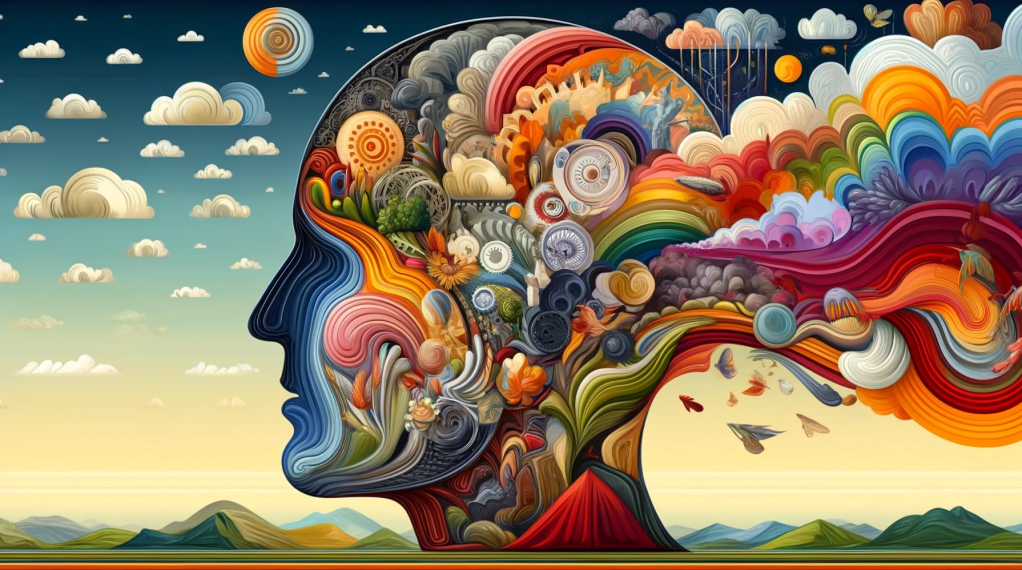
ChatGPT: Here’s the abstract and surreal artwork inspired by the concept “What’s on a Man’s Mind?”, re-imagined with various symbolic elements. Feel free to explore how different thoughts and preoccupations are visually represented in this image.


Leave a Reply