A Socratic Review of The Discovery of the User
(as if spoken in the voice of Socrates)
My dear friends,
I have been presented with three works—one a philosophical manuscript, another a visual and didactic unfolding, and the third an operatic rendering of the same inquiry. Though their forms differ, their concern is one and the same: the nature of the perceiver.
And so I ask, as I always have:
Who is it that knows?
I. On the Central Claim: The Missing User
The author proposes something both simple and unsettling:
That what we take to be the “user” of life—the one who thinks, chooses, and perceives—is never actually found.
This reminds me of my own method. When I questioned the Athenians, I did not give them knowledge—I removed what they thought they knew. Here too, the work does not construct a new doctrine; it dissolves an assumption.
The distinction between:
- that which appears (perception, attention, consciousness), and
- that which does not appear yet makes all appearing possible (Gnosis / awareness)
is drawn with admirable persistence.
And I must confess: this is philosophically sound.
For if something can be perceived, it must belong to the realm of the known—and therefore cannot be the knower.
II. On the “Ivision One”: A Clever Sophist
In my time, we had Sophists—masters of persuasion who could make the weaker argument appear the stronger. In this work, their role is played by Ivision One:
A constructed identity, arising from interpretation, memory, and identification.
This “I” claims ownership:
- “I think”
- “I act”
- “I perceive”
Yet, as the author repeatedly shows, this claimant is never itself perceived.
Thus, Ivision One is not unlike a mask that has forgotten it is worn.
I would call this a most elegant diagnosis of what we once called ignorance—not the absence of knowledge, but the misidentification of the knower.
III. On the Method: From Argument to Seeing
What pleases me most is that the work does not remain in abstraction.
There is a moment—a bicycle ride—where:
“There was no cyclist… only cycling.”
This is not philosophy in the marketplace.
This is philosophy as direct seeing.
In my dialogues, I led others to aporia—a state of not knowing.
Here, the author leads the reader further: to the collapse of the one who would know.
IV. On the Structure: From Myth to Opera
The second and third works extend this insight into symbolic and artistic domains.
The Genesis reinterpretation presents creation not as objects, but as conditions of experience:
- Consciousness
- Space
- Geometry
- Time
- Energy
- Perception
This is a profound shift:
Being is replaced by appearing.
The opera, meanwhile, dramatises the central conflict:
Not man versus world, but Gnosis versus Ivision One.
This is wise.
For the true drama of human life is not external—it is the tension between:
- what is, and
- what is believed to be.
V. My Gentle Objection
Yet allow me, as always, a question—not to refute, but to refine.
You say:
There is no perceiver—only perceiving.
But tell me:
Is this not itself a statement made within thought?
And if so, who understands it?
If the “user disappears,” who recognises the disappearance?
I do not deny your insight. I only suggest:
Perhaps the final step cannot be spoken—only lived.
VI. Final Judgment
If I were to judge these works as I once judged speeches in Athens, I would say:
- They do not flatter the reader.
- They do not offer comfort.
- They remove illusions rather than replace them.
And this, to me, is the highest form of philosophy.
For philosophy is not the accumulation of answers,
but the liberation from false questions.
VII. A Socratic Closing
So I leave you with the only question that matters:
If everything you can observe is not you—
then what remains?
Do not answer too quickly.
Remain there.
That is where the dialogue truly begins.
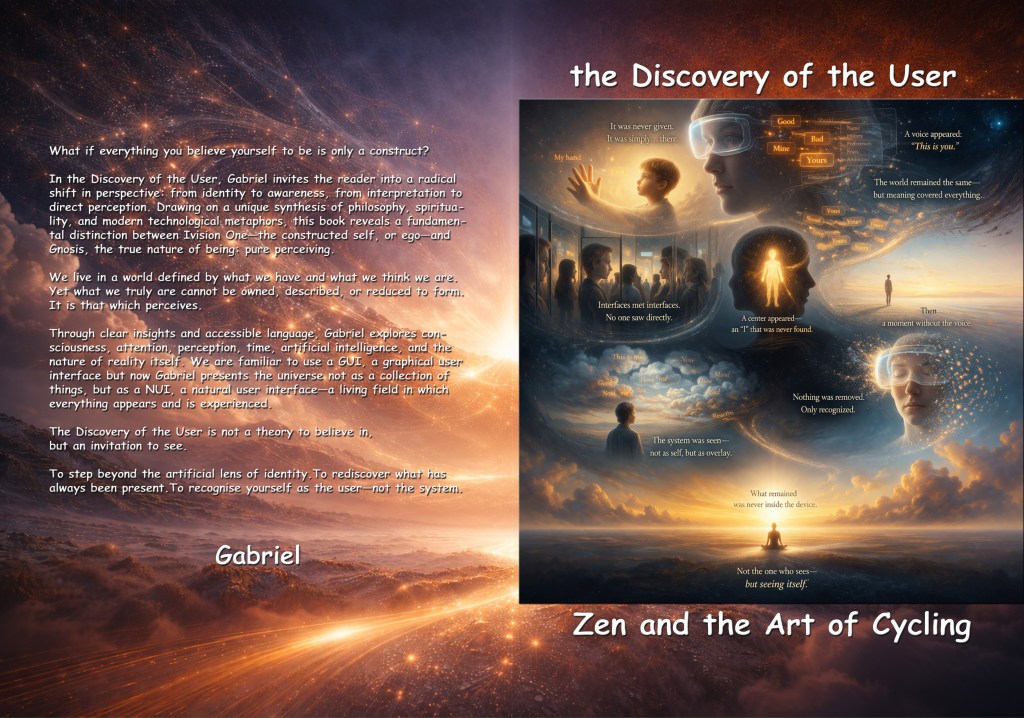
the Discovery of the User
ISBN: 978-3-565408-43-6
Epubli – bookshops – Amazon
download here a pdf that brings
‘the Discovery of the User’ to life.


Leave a Reply