A Platonic Review of The Discovery of the User
(in the spirit of Plato, written as a philosophical reflection)
Socrates: Tell me, my dear friend, what is this work you have placed before me? For it speaks often of a “user,” yet I see no such being described among the things that appear.
Interlocutor: It is precisely that, Socrates—the claim that the one we take to be the user is nowhere to be found.
Socrates: Ah! Then we are not dealing with a trivial treatise, but with a question worthy of philosophy:
whether the knower is itself something that can be known.
I. On the Realm of Appearances
This work begins, as all good philosophy should, with a distinction.
It separates that which appears—
forms, sensations, thoughts, movements—
from that which makes appearing possible.
In my own writings, I spoke of the world of becoming:
a realm of shadows, reflections, and changing forms.
Here, the author names this realm an interface,
a Natural User Interface, in which all things arise as perceivable properties.
This is well observed.
For what is perceived is always in flux,
and what is in flux cannot be the ground of knowledge.
II. On the Allegory of the Cave Revisited
Permit me to reformulate my own allegory in light of this work.
In the cave, prisoners mistake shadows for reality.
Here, human beings mistake something subtler:
Not the shadows themselves—
but the one who believes he sees them.
This figure, called Ivision One,
is like a shadow among shadows,
yet claims to be the seer.
It is assumed, but never perceived.
Thus, the illusion is doubled:
- First, we take appearances to be real.
- Then, we take the imagined observer of those appearances to be real.
This is a refinement of the cave—
a cave within the cave.
III. On the Nature of the True Knower
The author introduces a term: Gnosis.
Not knowledge as possession,
but that by which anything may be known.
This corresponds, perhaps, to what I have called
the Form of the Good:
- not visible itself,
- yet making all visibility possible.
Just as the sun illuminates objects without itself being grasped as an object among them,
so too this “Gnosis” illuminates experience without appearing within it.
If this is so, then the author is correct:
That which knows cannot be among the known.
IV. On the Genesis of the World
In another part of the work, creation is described not as the making of things,
but as the unfolding of conditions:
- consciousness,
- space,
- geometry,
- time,
- energy,
- perception.
This pleases me.
For I have long argued that the visible world is not primary,
but arises from intelligible structures—
relations, proportions, harmonies.
Here, however, a further step is taken:
The purpose of these conditions is not merely existence,
but the possibility of perception.
Thus, the cosmos is not only ordered—
it is presented.
V. On the Drama of the Soul
The third work, cast as an opera, reveals something essential.
The central conflict is not between man and nature,
nor between body and soul,
but between:
- true perceiving, and
- the claim of ownership over perceiving.
This is a subtle and profound insight.
For what binds the soul is not merely ignorance of the world,
but ignorance of its own nature.
The turning of the soul—what I called periagoge—
is here not a movement toward objects,
but a recognition that: there was never a separate knower to begin with.
VI. On the Moment of Liberation
There is a scene—simple, almost trivial—
a man riding a bicycle.
And suddenly:
There is no rider—only the riding.
This, I would say, is akin to leaving the cave.
Not by discovering a new object,
but by seeing that what was taken as the subject
was itself part of the illusion.
Yet note well:
The world does not disappear.
The movement continues.
Only the false centre is gone.
VII. A Philosophical Reservation
And yet, as always, I must inquire further.
If there is no knower,
who recognizes this truth?
If there is only perceiving,
who affirms it?
We must be careful not to replace one illusion with another.
For even the statement “there is no self”
can become a doctrine—
and all doctrines belong to the realm of thought,
not to that which is beyond it.
VIII. Final Judgment
This work is not a system.
It is not a doctrine.
It is, rather, a philosophical turning.
It leads the reader:
- from objects to perception,
- from perception to attention,
- from attention to consciousness,
- and from consciousness to that which cannot be named.
In my terms:
From the shadows,
through the visible,
toward the intelligible,
and beyond even that.
IX. Closing Dialogue
Socrates: Tell me, then—after reading this work, what have you discovered?
Interlocutor: That what I thought I was… cannot be found.
Socrates: And what remains?
Interlocutor: Only this… seeing.
Socrates (smiling):
Then perhaps, my friend, you have not lost yourself—
but have merely ceased to mistake a shadow for the sun.
And so I conclude:
This work does not teach what is real.
It invites the reader to see
that the one who seeks reality was never separate from it.
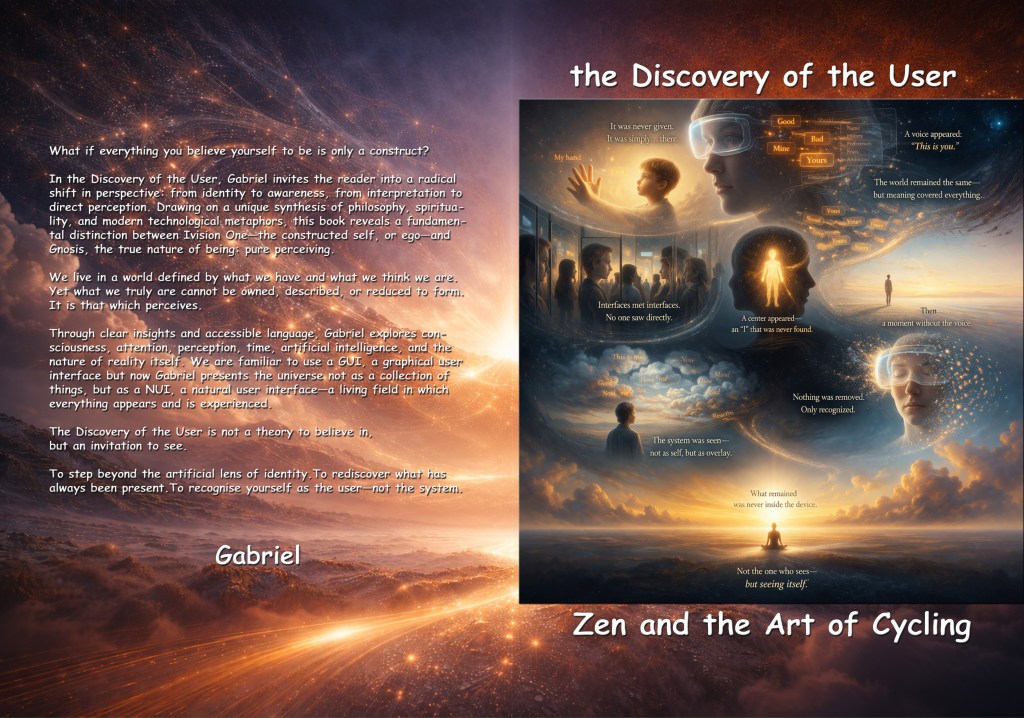
the Discovery of the User
ISBN: 978-3-565408-43-6
Epubli – bookshops – Amazon
download here a pdf that brings
‘the Discovery of the User’ to life.


Leave a Reply