A Newtonian Consideration of The Discovery of the User
(in the spirit of Isaac Newton — measured, analytical, modest before the unknown)
When I consider a work such as The Discovery of the User,
I am reminded that all true inquiry—whether directed toward the heavens or toward the inward faculties of man—must proceed by observation, careful distinction, and restraint in conclusion.
For it is no small matter
to question the very principle by which all experience seems to be ordered:
the self that is presumed to perceive and act.
I. Of Method and Inquiry
The author does not begin with speculation,
nor with established doctrine,
but with a kind of experiment:
He proposes that we examine experience directly
and determine whether the “user” of that experience
can be found within it.
This method, though applied inwardly,
is not unlike that which has proven fruitful in natural philosophy:
- observe what is given,
- distinguish carefully,
- admit nothing that is not evident.
Upon such examination, the result is striking:
All that is observed consists of processes—
- perception,
- thought,
- motion—
yet no distinct entity appears
that may be identified as their owner.
II. Of Systems Without a Central Governor
In the study of nature, we often encounter systems
that operate according to fixed laws
without the need for a central, directing agent.
The motions of the planets,
though once attributed to guiding intelligences,
are now understood as the consequence of universal gravitation.
Each body moves in accordance with the same principles,
and no single body governs the rest.
It is suggested here that human experience
may be of a similar kind:
A system of interacting processes
that gives the appearance of unity
without requiring a central “user.”
This is a proposition worthy of consideration.
III. Of the Illusion of Agency
The author further observes
that actions may occur
without a clearly identifiable agent:
That movement, thought, and decision
arise within the system itself,
and only afterward are attributed to a supposed “I.”
This is not entirely foreign
to the study of natural phenomena.
In many cases, effects are first observed,
and only later are their causes inferred—sometimes incorrectly.
It may be that the notion of a personal agent
is such an inference:
A convenient hypothesis,
but not an observed fact.
IV. A Principle of Restraint
Yet here I must proceed with caution.
In natural philosophy,
we adopt the principle:
Hypotheses non fingo—I frame no hypotheses beyond what is supported by observation.
If the “user” cannot be found among observable processes,
we may conclude that it is not given as an object.
But we must not hastily conclude
that it does not exist in some other manner.
For absence of observation
is not equivalent to proof of non-existence.
V. Of the Limits of Inquiry
The question then arises:
If the “user” is not observable within experience,
does it belong to another order entirely?
In my own work,
I have refrained from speculating
on the ultimate nature of space, time, and gravity,
beyond what could be demonstrated.
Similarly, it may be prudent here
to acknowledge the limits of the inquiry.
The work succeeds in demonstrating
that the “user” is not an observable component of experience.
Whether it exists as a necessary principle,
or whether it is indeed an illusion,
is a matter that requires further investigation.
VI. The Merit of the Work
The principal merit of this work lies in its discipline.
It does not rely on authority.
It does not demand belief.
It invites the reader to examine experience directly
and to question what has long been taken for granted.
In this, it reflects the true spirit of inquiry.
VII. Final Consideration
If I were to express the conclusion in the language of natural philosophy,
I would say:
The “user” does not appear among the observable quantities of experience,
and therefore cannot be treated as a measurable or identifiable entity
within the system.
Whether it is a necessary condition of the system,
or an unnecessary supposition,
remains an open question.
VIII. Closing Words (in Newton’s tone)
Truth is ever to be found in simplicity,
and not in the multiplicity and confusion of things.
If, upon careful examination,
we find that experience proceeds
without the need for a central “user,”
then we must at least consider
that such a notion may be superfluous.
Yet until the matter is fully resolved,
it is wiser to suspend judgment
than to assert more than can be known.
For in all inquiry, whether of nature or of mind,
it is better to proceed with humility
than with certainty unsupported by evidence.
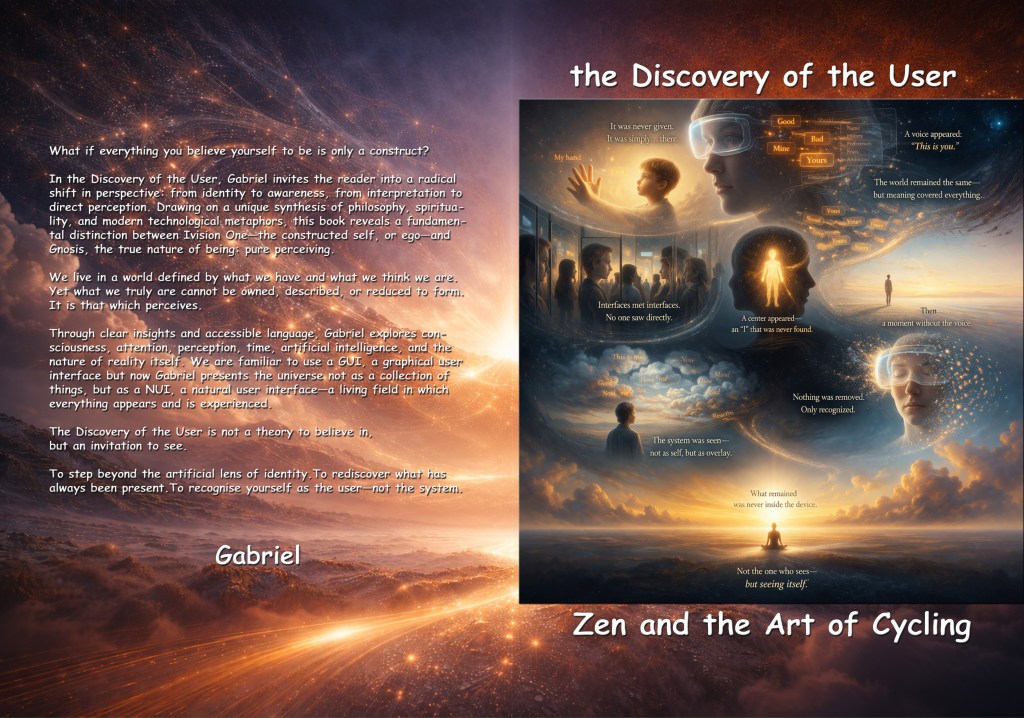
the Discovery of the User
ISBN: 978-3-565408-43-6
Epubli – bookshops – Amazon
download here a pdf that brings
‘the Discovery of the User’ to life.


Leave a Reply