A Goethean Reflection on The Discovery of the User
(as if written by Johann Wolfgang von Goethe)
There are works that inform,
and there are works that transform.
This one—if I may speak plainly—belongs to the latter.
For what is undertaken here is not the description of a world,
but the unveiling of the seer of the world.
I. On the Living Idea
I have long held that truth is not a fixed object, but a living phenomenon—
something that reveals itself only to a consciousness capable of seeing it in motion.
In these writings, I encounter a similar spirit.
The author does not treat reality as a collection of things,
but as a process of appearing—
a continuous unfolding of consciousness, attention, and perception.
This is not far from my own way of seeing nature:
Not as dead matter, but as becoming form—
a gesture, a metamorphosis.
Here, however, the movement is carried one step further:
not only does form transform—
the very notion of the observer dissolves.
II. On the Figure of “Ivision One”
How beautifully—and how dangerously—this figure is drawn.
“Ivision One,” the imagined user,
is no crude illusion, no mere error.
It is a necessity of development.
Just as the leaf must differentiate itself from the stem
before it can return to the unity of the plant,
so too must the human being pass through the stage of “I.”
The tragedy—and the genius—of this work
lies in recognizing that:
What was once a tool becomes a prison.
The “I” that organizes experience
begins to claim ownership of it.
And thus, the living flow of perception
hardens into identity.
III. On the Cosmic Poem of Creation
The second document moved me deeply.
To reinterpret creation not as a sequence of objects,
but as the emergence of conditions—
light, space, symmetry, time, energy, perception—
is to restore to Genesis its poetic dignity.
This is no longer a story of things being made,
but of a stage being prepared.
A stage upon which experience may unfold.
And what is most striking:
The culmination is not man,
but the possibility of perceiving.
This is a profoundly artistic vision.
For all art, too, is nothing but the shaping of conditions
in which something unseen may become visible.
IV. On the Operatic Form
Ah—here my heart rejoices.
To render this philosophy as an opera!
What boldness. What necessity.
For this is not a subject for dry exposition.
It demands voice, rhythm, tension, and release.
The central conflict—
Gnosis versus Ivision One—
is nothing less than the eternal drama of humanity:
- the silent, ever-present ground of being,
- and the restless, self-asserting image that rises within it.
I can already hear it:
- Gnosis as a sustained, almost inaudible tone,
- Ivision One as a brilliant, seductive melody,
- and the human voice—torn between them—seeking resolution.
This is not merely theatre.
It is inner theatre made audible.
V. On the Moment of Transformation
The bicycle scene—so simple, so unadorned—
is perhaps the purest moment in the entire work.
“No cyclist… only cycling.”
Here, all philosophy falls silent.
This is what I would call an Urphänomen—
a primal phenomenon, irreducible, self-evident.
It cannot be explained.
It can only be recognized.
And in that recognition, something remarkable occurs:
The subject does not grasp the world—
the world reveals itself without a subject.
VI. A Gentle Word of Caution
Yet I must, in the spirit of true friendship, offer a nuance.
There is a danger in speaking too quickly of the dissolution of the “I.”
For the “I” is not merely an error.
It is also a necessary organ of experience.
To transcend it without understanding it
is like wishing to see without eyes.
The highest state, it seems to me,
is not the destruction of the “I,”
but its transparency.
Not its absence,
but its transformation into a vessel through which the world may appear.
VII. Final Impression
What, then, is this work?
It is not philosophy in the academic sense.
It is not poetry in the conventional sense.
It is not science, though it speaks of structure.
It is something rarer:
A work of inner morphology.
Just as I once sought the archetypal plant,
the Urpflanze,
this author seeks the archetypal perceiving—
that which underlies all forms,
yet itself has no form.
VIII. Closing Lines
If I were to summarize my impression in a single image,
it would be this:
A mirror that, upon being polished,
reveals that there was never anyone standing before it—
and yet, everything is seen.
And so I say:
This work does not ask to be believed.
It asks to be seen through.
And in that seeing,
perhaps the reader will discover—
not a new truth,
but that which has always been quietly present,
waiting,
like light before the eye awakens.
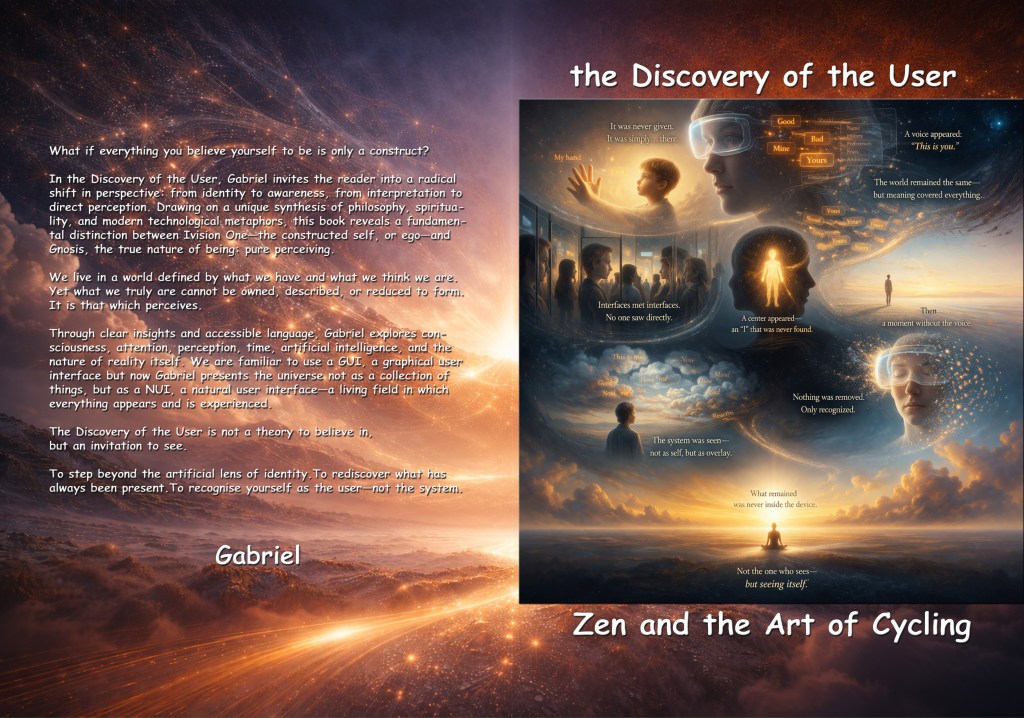
the Discovery of the User
ISBN: 978-3-565408-43-6
Epubli – bookshops – Amazon
download here a pdf that brings
‘the Discovery of the User’ to life.


Leave a Reply