A Schillerian Review of The Discovery of the User
(in the spirit of Friedrich Schiller — poetic, philosophical, and humanistic)
There are works that inform,
and there are works that awaken.
This one does not merely speak to the intellect—
it calls upon the whole human being:
to think, to feel, and ultimately… to see.
I. The Aesthetic Tension
In my letters on the aesthetic education of man,
I spoke of a tension within us:
- the sense drive, bound to form, matter, and time,
- and the form drive, aspiring toward unity, freedom, and the ideal.
Between them, I proposed a third—
the play drive (Spieltrieb)—
where freedom and form reconcile.
What I find in this work is a striking parallel.
The human being appears here divided:
- between the mechanical unfolding of life (body, perception, condition),
- and the inner claim of authorship—
the “I” that believes itself to act.
Yet neither is ultimate.
For what emerges, beyond both necessity and illusion,
is a kind of silent freedom—
not the freedom to act,
but the freedom of being unbound by the illusion of the actor.
This, I dare say, is a new aesthetic freedom:
Not the freedom to shape appearances—
but the freedom from being confined within them.
II. The Tragedy of Identification
Every great drama rests upon a misunderstanding.
Here, the tragedy is not political, nor moral—
but existential.
A child speaks the word “I,”
and in that innocent gesture
a fiction is born:
A centre is assumed
where none exists.
From this moment, humanity enters its quiet suffering:
- striving to control what unfolds,
- claiming ownership of what appears,
- and defending a self that was never found.
This is not sin in the theological sense—
but a misreading of existence.
Aesthetic man, as I once envisioned him,
is torn between forces.
But here, the tearing itself is revealed
to be the result of a mistaken identity.
III. The Opera of Becoming and Dissolution
How fitting that one of these works takes the form of an opera.
For what is life, if not a stage
upon which forms arise, interact, and dissolve?
And yet—what a subtle reversal!
In classical drama, the hero seeks resolution.
Here, resolution comes only when
the hero himself dissolves.
Not in death—
but in recognition.
The culmination is not triumph,
but transparency.
The voice remains,
the music continues,
the movement flows—
But no one stands behind it claiming:
“I am the one who does this.”
This is a new kind of catharsis:
Not the purification of emotion—
but the release from authorship.
IV. The Beautiful and the True
I have long argued that beauty is the gateway to truth.
And indeed, this work does not argue its case—
it reveals it.
Through image, through metaphor, through lived scenes:
- a child learning to ride a bicycle,
- a life unfolding without a central doer,
- a world moving without command.
These are not abstractions.
They are aesthetic recognitions.
And in them, something extraordinary occurs:
The reader does not merely understand—
the reader recognises.
As if something always known,
but never clearly seen,
suddenly stands unobstructed.
V. A Gentle Warning
And yet, as a poet of freedom,
I must offer a word of caution.
There is a danger in every revelation:
That it becomes doctrine.
If one says, “There is no self,”
and clings to this as belief,
then one has merely exchanged one chain for another.
True freedom cannot be held—
it can only be lived.
And what this work offers is not a conclusion,
but an opening:
A space in which the human being may stand
without compulsion, without illusion,
and without the burden of self-creation.
VI. Final Reflection
What, then, is the achievement of this work?
It does not construct a system.
It does not impose a worldview.
It performs something far more delicate:
It restores the human being to immediacy.
Not as thinker,
not as actor,
not as possessor of identity—
but as the living presence
in which all appearing unfolds.
VII. Closing Lines (in Schiller’s Spirit)
Man sought himself in thought
and lost himself in the search.
He named himself “I”
and became a stranger to what is.
But when the name falls silent,
and the claim dissolves,
there remains—
not emptiness,
but a fullness without centre,
a life without owner,
a seeing without seer.
And in that, perhaps,
lies the highest aesthetic state:
Not the harmony of opposing forces—
but the quiet disappearance
of the one who believed himself divided.
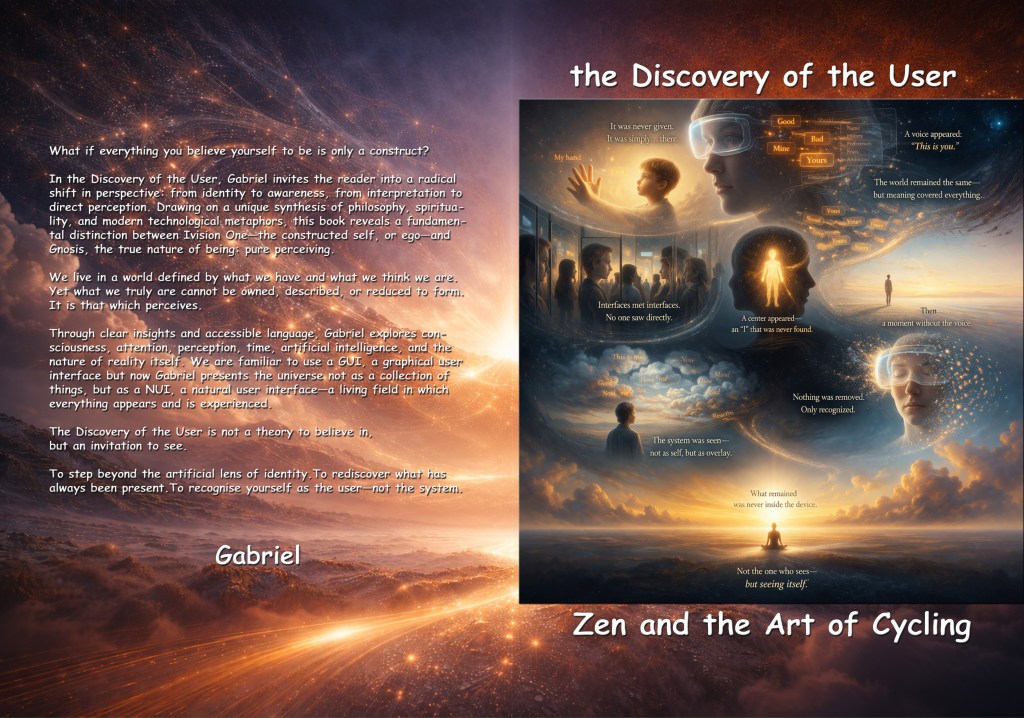
the Discovery of the User
ISBN: 978-3-565408-43-6
Epubli – bookshops – Amazon
download here a pdf that brings
‘the Discovery of the User’ to life.


Leave a Reply