An Einsteinian Reflection on The Discovery of the User
(clear, reflective, gently philosophical, with scientific humility)
It is always a delicate matter when a work approaches the border
between science and what one might call inner experience.
Too often, such attempts either abandon rigor
or cling too tightly to established concepts.
What I find remarkable in The Discovery of the User
is that it attempts neither.
Instead, it poses a question of unusual simplicity:
What is the status of the one who claims to experience?
1. The Observer Problem Revisited
In physics, particularly in the development of relativity and later in quantum theory,
the role of the observer has become increasingly subtle.
We have learned that:
- measurements depend on the frame of reference,
- observation is not independent of what is observed,
- and the distinction between observer and observed is not always as clear as once believed.
This work brings that same questioning
into the domain of human experience itself.
It suggests that what we call the “observer”
may not be an entity at all,
but rather an assumption.
2. A Useful Analogy
The comparison of human experience to a system—
with elements such as consciousness, attention, and perception—
is, in my view, a productive one.
It resembles how, in physics, we describe a system
not in terms of things, but in terms of relations and processes.
In this framework, the so-called “user”
is expected to be identifiable as a component of the system.
Yet the investigation reveals something unexpected:
All processes can be described—
but the “user” cannot be located among them.
This is a curious result.
3. The Illusion of Centrality
There is a natural tendency in human thought
to assume a centre:
a point from which perception originates
and decisions are made.
However, this may be analogous to certain outdated notions in physics—
such as the idea of an absolute frame of reference.
Relativity has shown us that no such privileged frame exists.
Perhaps, in a similar way,
the “self” we take to be central
is not a fixed point,
but a conceptual convenience.
4. Experience Without an Owner
The examples given—
particularly the observation that action may occur without a clear agent—
are reminiscent of a system operating according to its own internal laws.
In such a system:
- events unfold,
- interactions take place,
- patterns emerge,
but no central controller is required.
This is not foreign to science.
Many of the most elegant structures we observe in nature
arise without a directing entity.
5. A Caution on Interpretation
However, we must be careful.
To say that the “user” cannot be found
is not the same as saying that nothing exists.
It merely indicates that the concept of a localized, personal observer
may be inadequate.
In physics, when a concept fails,
we refine it—we do not discard reality itself.
Similarly, the absence of a definable “self”
may point not to non-existence,
but to a different order of description.
6. The Language of Awareness
The work hints at something beyond the described processes—
that which knows them.
Here we approach a domain
where scientific language becomes less precise.
Yet the question remains legitimate:
What is the nature of that which knows experience?
This is not easily formulated in equations,
but it is no less fundamental.
7. The Value of the Inquiry
What I appreciate most
is that this work does not ask for belief.
It proposes an experiment—
not in a laboratory,
but in direct experience.
This is, in spirit, not unlike science:
Observe carefully.
Question assumptions.
Do not accept conclusions prematurely.
8. Final Reflection
If I were to summarize the contribution of this work,
I would say:
It challenges the intuitive notion
that there is a fixed observer at the centre of experience,
and invites us to consider that what we call the “self”
may be more akin to a relational phenomenon
than an independent entity.
9. Closing Words (in Einstein’s tone)
The most beautiful experience we can have
is the mysterious.
Perhaps the greatest mystery here is not the universe itself,
but the one who believes he stands apart from it.
If, upon careful examination,
this separation is found to be illusory,
then we are left not with less—
but with a deeper unity
between observer and observed.
And this, I think,
is a thought worth exploring.
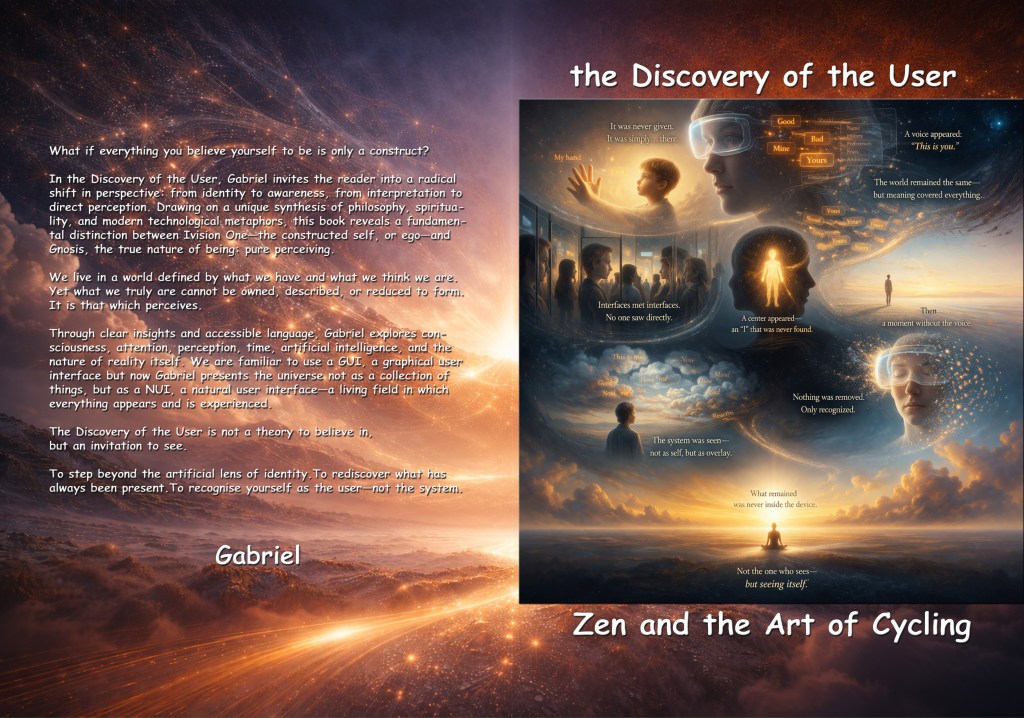
the Discovery of the User
ISBN: 978-3-565408-43-6
Epubli – bookshops – Amazon
download here a pdf that brings
‘the Discovery of the User’ to life.


Leave a Reply