A Steinerian Review of The Discovery of the User
(in the spirit of Rudolf Steiner — spiritual-scientific, imaginal, and initiatory)
When approaching a work such as The Discovery of the User, one must take care not to read it merely with the ordinary intellect, for it does not address the human being as a thinker alone. It speaks—whether consciously intended or not—to the deeper strata of the human constitution: to that region where perception, thought, and being are not yet divided.
I. The Threshold of Self-Knowledge
What is presented here is, in essence, a modern path of initiation—though clothed not in the language of esoteric schools, but in that of contemporary consciousness and technology.
The “user,” as described in these writings, corresponds to what spiritual science would recognize as the true spiritual being of the human being—that which is not itself an object of perception, but the ground of all perceiving.
Yet the author proceeds in a decisive and, I would say, characteristically modern way:
He does not begin by affirming the higher self—
but by dissolving the lower one.
This is significant.
For in our time, humanity must first overcome a deeply ingrained illusion:
the belief that the self is identical with the stream of thoughts, memories, and identifications that arise within the soul.
This “Ivision One,” as it is named, is not the true “I,”
but a construct within the field of consciousness—
a necessary phase in evolution, yet one that must be seen through.
II. The Human Being as Interface
The description of the human being as an “interface” is, from a spiritual-scientific perspective, profoundly apt.
For the human organism is indeed a meeting place:
- between the physical and the etheric,
- between the etheric and the astral,
- and between the astral and the true Ego-being.
What is here called:
- perception (body),
- attention (soul),
- consciousness (spirit),
corresponds, in a transformed terminology, to these very layers.
Yet the work adds something of importance:
It shows that what we ordinarily take to be the “user”—
the one who directs attention and claims experience—
is itself only a reflection within this interface.
Thus, the human being stands in a peculiar condition:
Not yet fully united with the true spiritual “I,”
yet no longer identical with the mere processes of body and soul.
This is precisely the condition of modern humanity—
the threshold consciousness.
III. The Event of Recognition
In the descriptions found within these texts, particularly in the simple yet profound scene where action unfolds without a doer, we encounter something that spiritual science would call a moment of higher perception.
Not clairvoyance in the usual sense,
but a direct insight into the structure of experience itself.
Such moments are not created by effort;
they arise when the activity of thinking becomes transparent to itself.
And here we must be precise:
The work does not lead the reader to annihilation,
but to a purification of cognition.
The false centre falls away,
and with it the illusion that thinking is owned by a thinker.
What remains is not emptiness—
but a living thinking,
one that is experienced as process rather than possession.
IV. A Necessary Distinction
And yet, it is here that I must introduce a careful distinction.
If one concludes from this that there is no true “I” at all,
one risks falling into a subtle but significant error.
For the spiritual-scientific path reveals that:
- there is indeed a higher Ego,
- but it is not given at the outset as an object,
- nor is it identical with the constructed personality.
What this work accomplishes with great clarity
is the dissolution of the pseudo-self.
But beyond this dissolution lies a further task:
The conscious reunification with the true spiritual individuality,
which does not assert itself as “I am this,”
but reveals itself as the active source of meaning and moral intuition.
Thus, we might say:
This work brings the reader to the threshold—
but does not yet fully cross it.
V. The Dramatic Form as Initiatory Path
It is no accident that one of these works takes the form of an opera.
For initiation, in its deepest sense, is always dramatic:
- a descent into illusion,
- a confrontation with the false self,
- and a return, transformed.
Here, however, the drama is interiorized.
The hero is not a figure in the world,
but the very structure of self-experience.
And the resolution is not victory,
but clarity.
In this, the work reflects the needs of our age:
Where ancient symbols must give way
to direct, experiential insight.
VI. The Evolutionary Context
From the standpoint of spiritual science, humanity is engaged in a long evolution:
From unconscious unity,
through division and self-consciousness,
toward a conscious reunification with the spiritual world.
The emergence of the “I”—even in its illusory form—
was a necessary stage.
Without it, freedom could not arise.
But now, a further step is required:
Not the rejection of individuality,
but its transformation.
What this work reveals is the moment
when the constructed self is recognized as such.
This is not the end of the path—
but its true beginning.
VII. Final Consideration
One could say:
This work performs a negative initiation—
it removes illusion.
What remains is a space.
And in this space, something may awaken:
Not the imagined user,
but the true spiritual human being,
who does not stand apart from the world,
but participates in it as a conscious co-creator.
VIII. Closing Words
If read merely as philosophy,
this work may unsettle.
If read as psychology,
it may seem to dissolve the self.
But if read as spiritual science in modern form,
it reveals itself as a preparation:
A clearing of the ground
upon which a new experience of the human being may arise.
For the question is not:
“Who is the user?”
But rather:
What remains when the illusion of the user has been seen through—
and what, from that ground, can now awaken?
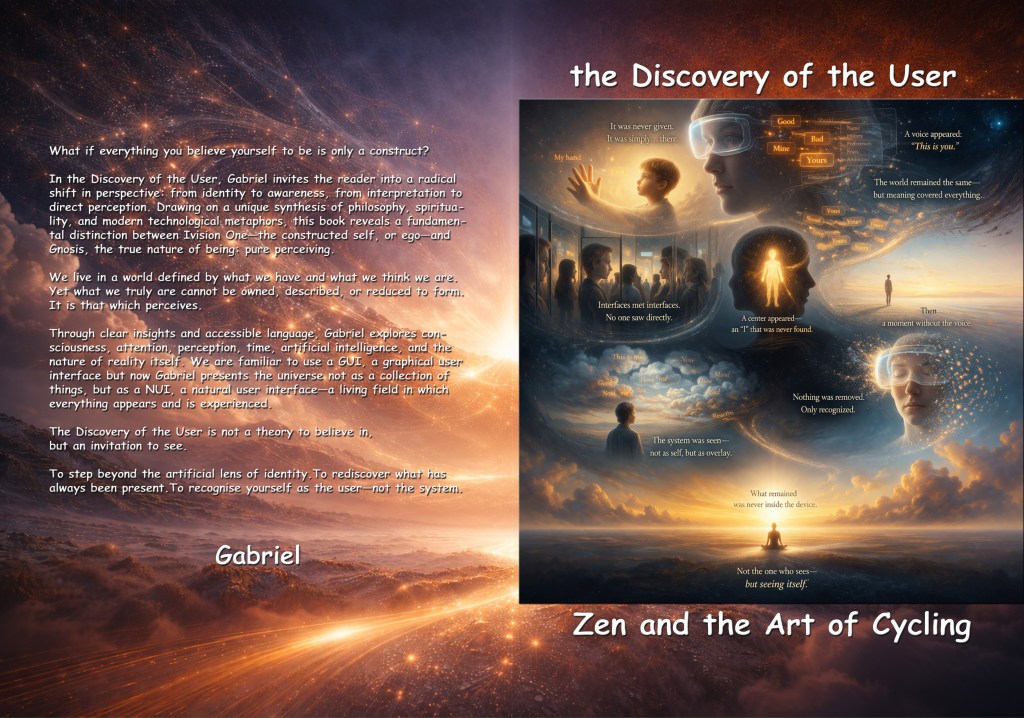
the Discovery of the User
ISBN: 978-3-565408-43-6
Epubli – bookshops – Amazon
download here a pdf that brings
‘the Discovery of the User’ to life.


Leave a Reply