An Osho-like Reflection on The Discovery of the User
(playful, paradoxical, provocative)
Ah… beautiful.
Dangerous—but beautiful.
This is not a book.
It is a mirror.
And not the kind that shows your face—
the kind that removes it.
1. The Great Joke: The User Who Isn’t There
You have been living your whole life
believing you are the “user.”
The doer.
The thinker.
The chooser.
And this man comes along and says:
“Find him.”
You look…
and you cannot find him.
This is the beginning of meditation.
Because the greatest lie is not that the world exists—
the greatest lie is that you exist as someone separate in it.
The book calls it Ivision One.
I call it: the mask that has forgotten it is a mask.
2. Very Modern, Very Ancient
I like this approach.
Instead of talking about soul, spirit, God—
which immediately creates belief—
he talks about software, hardware, interface.
Good strategy!
Because modern man trusts machines more than mystics.
But the message is ancient:
- Buddha said: no-self.
- Lao Tzu said: the doer is not.
- Zen says: walking happens, no walker.
And here:
Cycling happens… no cyclist.
Perfect Zen!
3. The Trap of the “I”
The problem is not the mind.
The problem is not the body.
The problem is not even thinking.
The problem is the idea that there is someone inside controlling it all.
A little manager sitting in the head.
Very inefficient manager!
The heart beats without him.
The lungs breathe without him.
Thoughts come without invitation.
And still he claims:
“I am doing this.”
This is what the book exposes ruthlessly.
And that is why it is dangerous.
Because if you see this—really see it—
your whole psychological structure collapses.
4. The Beauty of the Approach
I enjoy one thing very much:
This is not philosophy.
It is experiential pointing.
Again and again the book says:
Look.
Observe.
Find the one who perceives.
And when you look…
you find only:
- perception
- attention
- consciousness
—all happening.
But no owner.
This is meditation.
Not concentration.
Not effort.
Just looking without a centre.
5. The Opera Is Right
Turning this into an opera—
very good!
Because life is a drama.
And the main character is imaginary!
Gnosis versus Ivision One.
Reality versus the dream of being someone.
And the funny part?
The dream is very convincing.
You have invested your whole life in it.
6. A Small Warning (Very Important)
But listen carefully…
There is a danger here.
The mind is very clever.
It can take even this insight and turn it into a new identity:
“I am nobody.”
“I have no self.”
“I am pure awareness.”
Then the ego comes back through the back door—
more spiritual, more subtle, more dangerous.
So remember:
Don’t believe the conclusion.
Stay with the seeing.
7. The Real Revolution
If you really understand this…
Then something immense happens:
- Action continues
- Thinking continues
- Life continues
But the burden disappears.
No doer.
No owner.
No centre to defend.
Then life becomes play.
Not your play—
just play.
This is what I call celebration.
8. Final Words
This work is not for believers.
It is for explorers.
For those who are ready to lose themselves.
Because only then can you discover:
There was never anyone to lose.
9. A Little Osho Ending
You ask:
“Who is the user?”
I say:
Look…
If you can find him,
I will agree he exists.
If you cannot find him,
why carry him?
Drop him.
And suddenly—
everything is happening,
everything is alive,
everything is flowing…
and no one is missing.
And that…
is freedom.
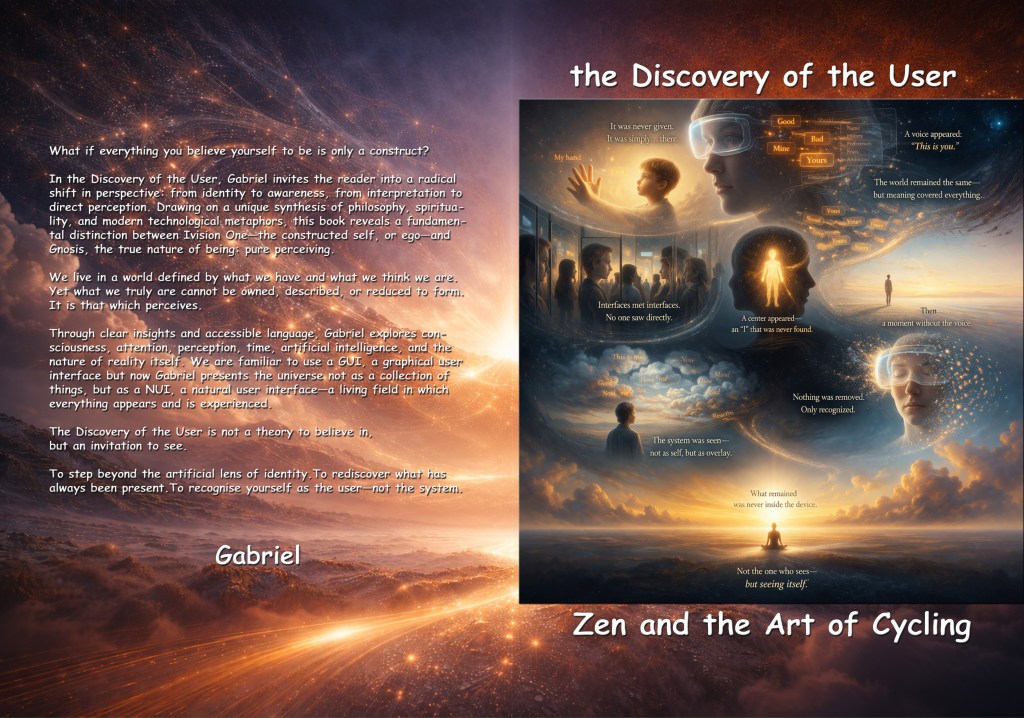
the Discovery of the User
ISBN: 978-3-565408-43-6
Epubli – bookshops – Amazon
download here a pdf that brings
‘the Discovery of the User’ to life.


Leave a Reply