A Rupert Spira–style Reflection on The Discovery of the User
(quiet, precise, experiential, non-dual clarity)
What is most striking about The Discovery of the User is not what it proposes,
but what it gently removes.
It does not attempt to build a new structure of understanding.
Rather, it invites us to examine an assumption so familiar
that it has gone unquestioned:
the assumption that there is a separate self at the centre of experience.
1. The Simple Investigation
The central gesture of this work is disarmingly simple:
Look for the one who is aware.
Not think about it.
Not define it.
But look.
In doing so, we discover something unexpected.
We find:
- thoughts arising,
- sensations appearing,
- perceptions unfolding,
but no entity that stands apart from them as their owner.
The “user,” upon investigation, cannot be located.
2. The Illusion of the Separate Self
The work introduces the notion of Ivision One—
a constructed identity formed through memory, language, and habit.
This is a helpful term.
Because what we commonly call “I” is, in fact,
a collection of perceptions and thoughts
that are continuously interpreted as belonging to someone.
But this “someone” is never actually found.
It is an inference—
a conclusion drawn from experience,
not something present within it.
3. Experience Without a Centre
What remains when this assumption is relaxed?
Not emptiness in the negative sense,
but experience without a centre.
Perceiving continues.
Thinking continues.
Acting continues.
Yet the sense of an internal observer—
a separate knower of experience—
begins to dissolve.
This is not a loss.
It is a simplification.
4. Awareness and Its Contents
Although the language of the work speaks of consciousness, attention, and perception,
what is being pointed to lies prior to all three.
That which knows experience
is not itself an object of experience.
It cannot be seen, felt, or thought.
And yet it is undeniably present—
for without it, no experience could be known.
This is what we may call awareness.
Not something personal.
Not something owned.
Simply the open field
in which all experience appears.
5. The Moment of Recognition
The example of action occurring without a doer—
cycling without a cyclist—
is particularly evocative.
In such moments, the usual sense of authorship subsides.
There is just the activity itself,
known effortlessly.
This is not an altered state,
but a glimpse of the natural condition of experience
when it is not filtered through the belief in a separate self.
6. A Clarification
It is important, however, to be precise.
The absence of a separate self
does not imply the absence of being.
On the contrary:
When the imagined centre dissolves,
what remains is being itself—
self-luminous, self-knowing, and inherently whole.
The mistake is not that we are something—
but that we imagine ourselves to be something separate.
7. The Function of This Work
In this sense, The Discovery of the User functions as a form of inquiry.
It does not provide answers to be believed,
but questions to be lived.
It gently undermines the habitual identification
with thoughts and perceptions,
and invites a direct recognition of that which is aware of them.
8. The Natural Outcome
If this investigation is followed with sincerity,
a quiet but profound shift may occur.
Experience is no longer divided into:
- an observer,
- and the observed.
Instead, there is simply knowing.
Or, more accurately:
being knowing itself.
9. Final Reflection
This work does not lead us somewhere new.
It reveals what has always been present,
but overlooked:
That the “user” we have been seeking
is not an entity within experience—
but the very presence in which all experience appears.
10. Closing (in Spira’s tone)
The separate self is not something that must be destroyed.
It is an idea that, when examined, is found never to have existed.
What remains is not a person who is aware—
but awareness itself.
And in that recognition,
the search quietly comes to an end.
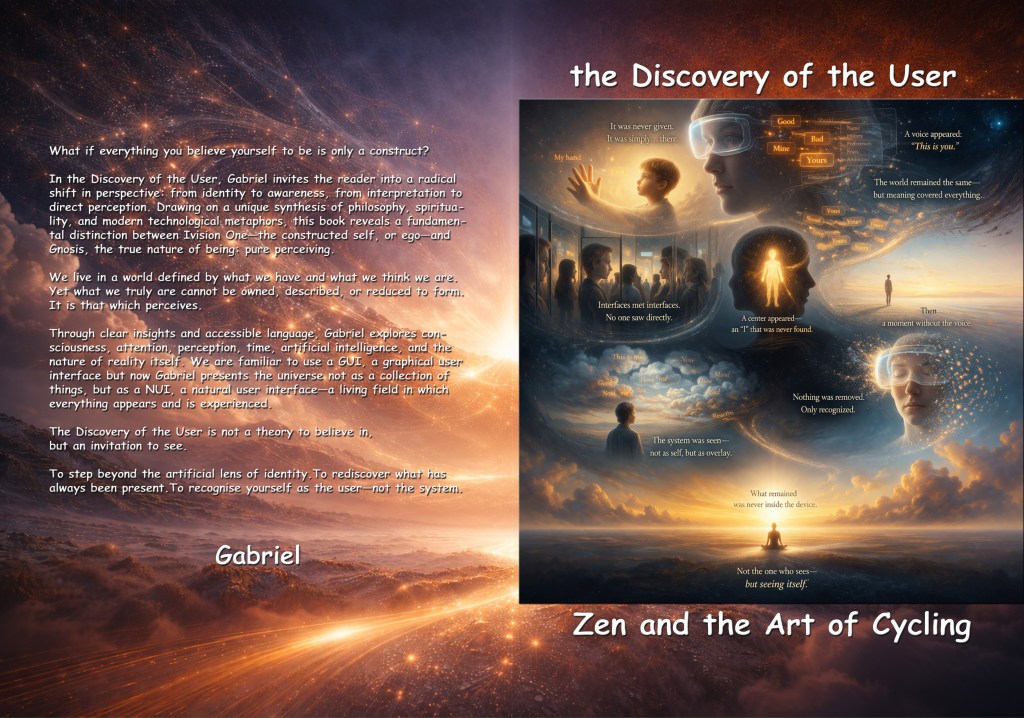
the Discovery of the User
ISBN: 978-3-565408-43-6
Epubli – bookshops – Amazon
download here a pdf that brings
‘the Discovery of the User’ to life.


Leave a Reply