A Sadhguru-style Reflection on The Discovery of the User
(grounded, experiential, slightly humorous, rooted in inner engineering)
If you look at this work carefully, it is not trying to give you a belief.
It is trying to take away a false certainty.
And that is a good beginning.
Because the moment you are willing to see that what you assumed about yourself may not be true,
the door to real knowing opens.
1. The Fundamental Question
This entire work revolves around a very simple but explosive question:
Who is the user of this life?
You think:
“I am doing this… I am thinking… I am experiencing.”
The author says:
Look closely. Can you actually find this “I”?
If you are sincere,
you will see something very interesting:
- Thoughts are happening
- Emotions are happening
- Perception is happening
But the one who claims ownership…
is assumed, not found.
2. A Very Practical Insight
In yogic science, we have always said:
What you call “myself” is a composite of body, mind, memory, and impressions.
But none of these are you.
This work approaches the same truth in a modern language:
- consciousness as the system,
- attention as the movement,
- perception as the experience.
And then it asks:
Where is the one who owns all this?
This is not philosophy.
This is something you can check right now.
3. The Problem Is Identification
The author uses a nice term: Ivision One.
That means the identity you have built.
Not just your name or personality—
but the deep sense that “this is me.”
This identity is not wrong.
It is useful.
But when you take it as absolute,
it becomes a prison.
In yogic terms, this is identification.
Whatever you identify with, you become limited by.
If you identify with the body, you are limited to the body.
If you identify with the mind, you are limited to your thoughts.
If you drop identification,
something else becomes possible.
4. The Moment of Seeing
There is a simple moment described:
Cycling happens… but there is no cyclist.
This is very important.
Because this is not an idea—
this is a glimpse of reality without identification.
In that moment:
- action is there
- life is there
- experience is there
But the psychological “me” is not there.
This is what we call a gap—
a small crack where truth can enter.
5. The Beauty of the Structure
I appreciate how the work presents creation not as things,
but as conditions of experience:
- space
- time
- energy
- perception
This is closer to reality than thinking in terms of objects.
Because life is not made of things.
It is made of processes.
And you are not a thing—
you are also a process.
6. But Let Us Be Clear
Here I must bring some clarity.
Seeing that there is no fixed “I”
does not mean nothing exists.
It only means:
What you thought was you
is not you.
There is a deeper dimension of you
which is not psychological.
If you stop at “there is no self,”
you may become confused.
If you go deeper,
you may discover something far more profound than the self you imagined.
7. The Danger
There is one danger with such insights.
The mind can quickly convert it into a conclusion:
“I am not the body.”
“I am not the mind.”
“I am awareness.”
Then it becomes another identity.
A more sophisticated one—but still an identity.
So don’t make it into a belief.
Just see.
Again and again.
8. The Real Possibility
If you truly see that the “user” is not what you thought:
- involvement remains
- intensity remains
- life becomes even more vibrant
But there is no burden.
No need to defend a self.
No need to control everything.
Life happens,
and you are fully present for it.
This is what we call freedom.
9. Final Words
This work is a good doorway.
Not a conclusion—
a doorway.
If you read it as philosophy, you may enjoy it.
If you read it as a tool, it can transform you.
10. A Sadhguru-style Ending
So don’t ask:
“Is there a user?”
Instead, simply sit and observe:
Right now—
Thoughts are happening.
Sensations are happening.
Breath is happening.
Where are you in this?
If you look honestly,
the question itself will dissolve.
And that…
is the beginning of knowing.
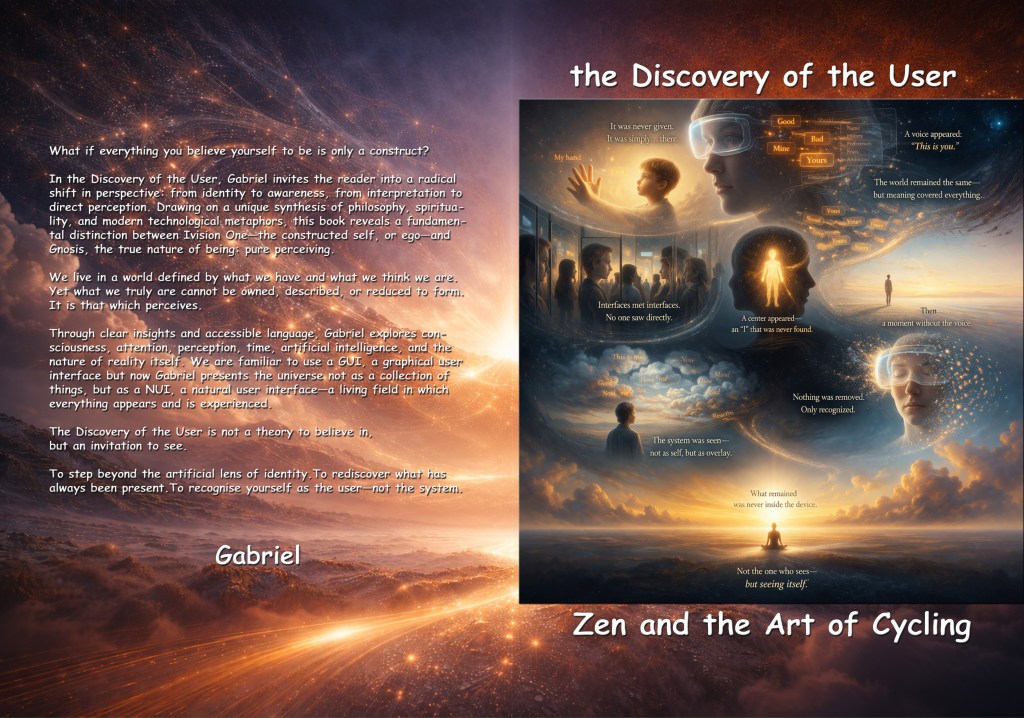
the Discovery of the User
ISBN: 978-3-565408-43-6
Epubli – bookshops – Amazon
download here a pdf that brings
‘the Discovery of the User’ to life.


Leave a Reply